
Amy Goodman is bounding up the stairs at a United Nations climate summit, quick on the heels of the Trump administration official ignoring her questions. Amy Goodman is winding after him through a hallway. Another hallway, another set of stairs.
“Can you tell me what you think about President Trump saying climate change is a hoax? Can you explain why the U.S. joined with Saudi Arabia in watering down language around the UN report?”
“Are you not speaking to the press while you’re here?”
Amy Goodman is having a door shut on her face.
So goes the opening scene of Steal This Story, Please!, a new documentary from veteran filmmakers Tia Lessin and Carl Deal that traces the career of independent news journalist Goodman, host of the global news program Democracy Now! The documentary opens in select theaters nationwide on April 10 and will screen at Durham’s Full Frame Documentary Film Festival on April 16.
Democracy Now! launched in 1996 as a scrappy news hour airing on just nine stations. Today, the program—which has managed to stay listener-funded, without corporate sponsorship, government funding, or advertising revenue—reaches a network of 1,500 public television and radio stations. It’s become known for reporting on grassroots movements like Arab Spring and Occupy Wall Street; in recent years, it has been one of the only media platforms where listeners could expect to hear consistent death toll updates from Israel’s war on Gaza.
Lessin was part of Goodman’s team covering the Republican National Convention in 2000, where the journalist was “chasing after politicians and billionaires and asking the hard questions.”
“She was covering it like an athletic event,” Lessin said with a laugh.
Lessin and Deal made their Full Frame debut in 2008 with Trouble in the Water, an Oscar-nominated documentary about the survivors of Hurricane Katrina, and were most recently at the festival in 2013 with Citizen Koch, an investigation into 2010’s Citizens United v. FEC Supreme Court ruling and its dire impact on campaign finance. (The documentary was dropped from PBS after pressure from financier David Koch.)
They are also frequent collaborators with Michael Moore—in fact, Deal recalls his first memory of Goodman was when he was with Moore, a figure who normally drew onlookers, at a protest during the Iraq War. The crowd was clustered elsewhere, and “nobody was coming to Michael,” Deal told the INDY. He looked around for the source.
“It was Amy. Amy was drawing the crowd away, because she was out there talking about media complicity and the media control measures being implemented by the Pentagon, at that time, and the Bush administration,” said Deal. “I saw her, and she was the rock star.”
For anyone who also looks up to Goodman’s dogged advocacy journalism, as I do, this is the documentary you didn’t know you’d been waiting for. It offers a refreshing portrait of a persistent value system, with a look at Goodman’s upbringing, as the granddaughter of an Orthodox rabbi in a family that embraced both social justice and curiosity as a lifelong practice.
“It came from my Jewish education that you asked questions and that you take nothing for granted,” Goodman says in the film. “And the way you deal with the world is with intense curiosity and not being afraid to stand by your principles.”
“It’s in Amy’s nature to care about the other person,” said Deal. “I didn’t ever assume she didn’t, but I understand it really profoundly, after I sat with her and her story for the last couple of years, seeing how deeply she cares about other people …. She doesn’t have to agree with you to be deeply interested in who you are, where you come from, and what you have to say.”
The film offers a glimpse of Goodman’s crunchy grind, with scenes of visits with her 105-year-old grandmother and bopping around the city with her dog, Zazu, a woven cross-body bag in tow. She has energy and “a lot of lightness,” according to Lessin, “and off-camera, she does like to find joy.”
Steal This Story, Please!, though, ultimately isn’t a character study, nor is it, as goes the usual line for legacy wonk documentaries, a “love letter to the profession.”
The film’s most profound insights about the industry are merely a reinforcement of its most basic principles: that those most impacted by harm should have their voices heard, and that those who hold the most power are responsible to answering questions from those who hold the least. As the film trawls through the 90s into the 2000s, it identifies consolidations of power, initiated across party lines, that have gotten us where we are today.
Where is that? There’s not enough space to list the existential threats to independent media and the degree to which the Trump administration has silenced and stomped out the press. But while our present crisis is a specter in Steal This Story, Please!, Deal and Lessin’s primary focus is on the ways mainstream media has long capitulated to power, put profit first, and shied from tough questions. This focus doesn’t minimize the challenges of today, but it does help us understand them better.
Scenes of newsroom challenges from twenty and thirty years ago feel eerily familiar, reminding viewers that corporate and political pressure has always been powerful, and that, as the Mark Twain quote goes, “history doesn’t repeat itself, but it often rhymes.” There are fascinating callbacks to moments like the Telecommunications Act that President Bill Clinton signed into law in 1996, which weakened guardrails against media monopolies and which, as Goodman’s Democracy Now! colleague Juan González observes in the film, “led to the privatization of the internet.”
The title Steal This Story, Please! nods to Goodman’s ethos that change happens when stories spread—and that, as Lessin said, “it’s a success if her stories are copied or taken up by other outlets.”
That challenge moves beyond journalists to anyone looking to preserve their humanity: In an era where we’re visually inundated with images of war and disaster, every time we punch in a phone passcode, there’s a call to metabolize information before it flickers out of sight—and maybe even to do something with it.
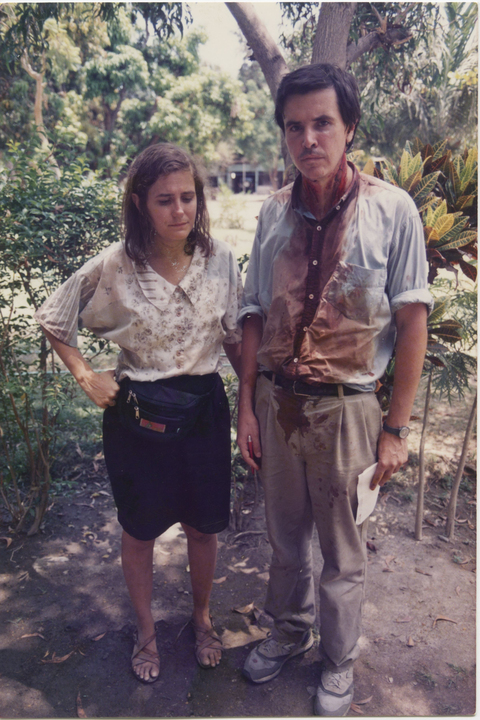
Early on, as Goodman rifles through a box of photos and press badges, she holds up a photo of herself and her bloodied colleague Allan Nairn. It was taken in East Timor, where Goodman and Nairn happened to be on assignment in 1991, the day the Indonesian army opened fire on a crowd of thousands of Timorese civilians, killing at least 271. The violence was not a one-off; during Indonesia’s occupation of Timor, between 1975 and 1999, as many as 200,000 people were killed by a regime “armed, financed, and trained” by the United States, as Goodman emphasizes.
“It would change us forever, and it taught me how critical it was that we expose what is done in our name,” Goodman says in the documentary.
She is not interested in pundits. She doesn’t want experts to opine on whatever is happening.
She’s interested in the people who are experiencing the fallout of foreign policy and the people,
as she says, at the trigger end
of the gun, or the target end
of the bomb.”tia lessin, filmmaker
Here is another essential part of Goodman’s practice: An insistence on the discipline of context, of helping viewers understand how events came to be. When Goodman and Nairn published coverage of the event, nationwide protests erupted. A little less than a year later, in November 1992, the House finally voted to cut off military funding for Indonesia.
“Her motto is, go to where the silence is,” said Lessin. “She is not interested in pundits. She doesn’t want experts to opine on whatever is happening. She’s interested in the people who are experiencing the fallout of foreign policy and the people, as she says, at the trigger end of the gun, or the target end of the bomb.”
She also isn’t—as one very fun scene evinces—interested in giving presidents special treatment or letting their position get in the way of a good interview.
The year is 2000. It’s Election Day and Clinton is making a round of get-out-the-vote calls. Unannounced, and perhaps ill-advised, he places one to the Democracy Now! studio. The team scrambles to get the conversation live, as Goodman picks up the phone.
“Hello, Mr. President,” Goodman says, and then, without missing a beat, begins: “What do you say to people who feel that the two parties are bought by corporations and that their vote doesn’t matter?”
This is followed by questions about Israel. Questions about NAFTA and the prison system and the state of the Democratic Party. Clinton calls her combative and hostile. But for more than 30 minutes, he also stays on the phone.
In another scene, Goodman is asked about the secret to her interview technique.
“It’s just showing up,” Goodman says, “and asking the questions nobody has bothered to ask.”
To comment on this story, email [email protected].