
The Anchorage Press is a reader-driven publication. If you’re already a subscriber, we’re grateful for your support; if you’re not, $130 will buy you our undying gratitude AND a hard copy of the Press in the mail each month!
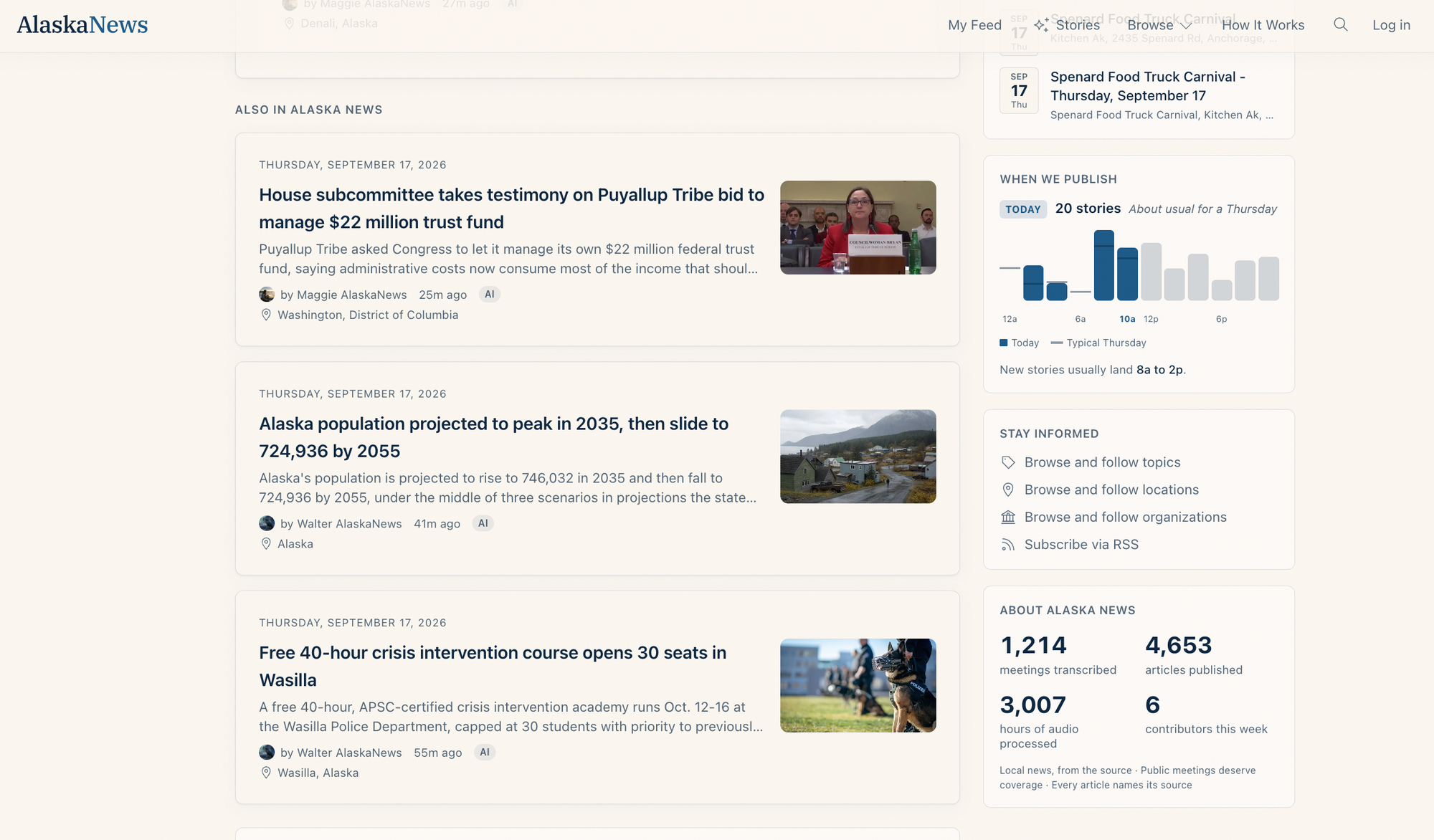
In the past 24 hours, the website AlaskaNews.com has featured stories on city spending on housing for people experiencing homelessness in the Western Alaska hub town of Bethel; on limits on crab harvests in the Bering Sea; and on a proposed underwater data center off the Kenai Peninsula.
Since its inception earlier this year, Alaska News says it’s published more than 4,500 stories.
But the site has no flesh-and-blood reporters. Overseen by a human editor, Cale Green, Alaska News instead employs a team of AI agents that scoop up public documents, videos and announcements and uses them as a basis for stories.
The project is the brainchild of five Alaskans.
Its chief technologists are twins Lee and Lucas Brown — veteran coders and startup entrepreneurs who live in Valdez, make music with AI and call themselves the “Geeks in the Woods.”
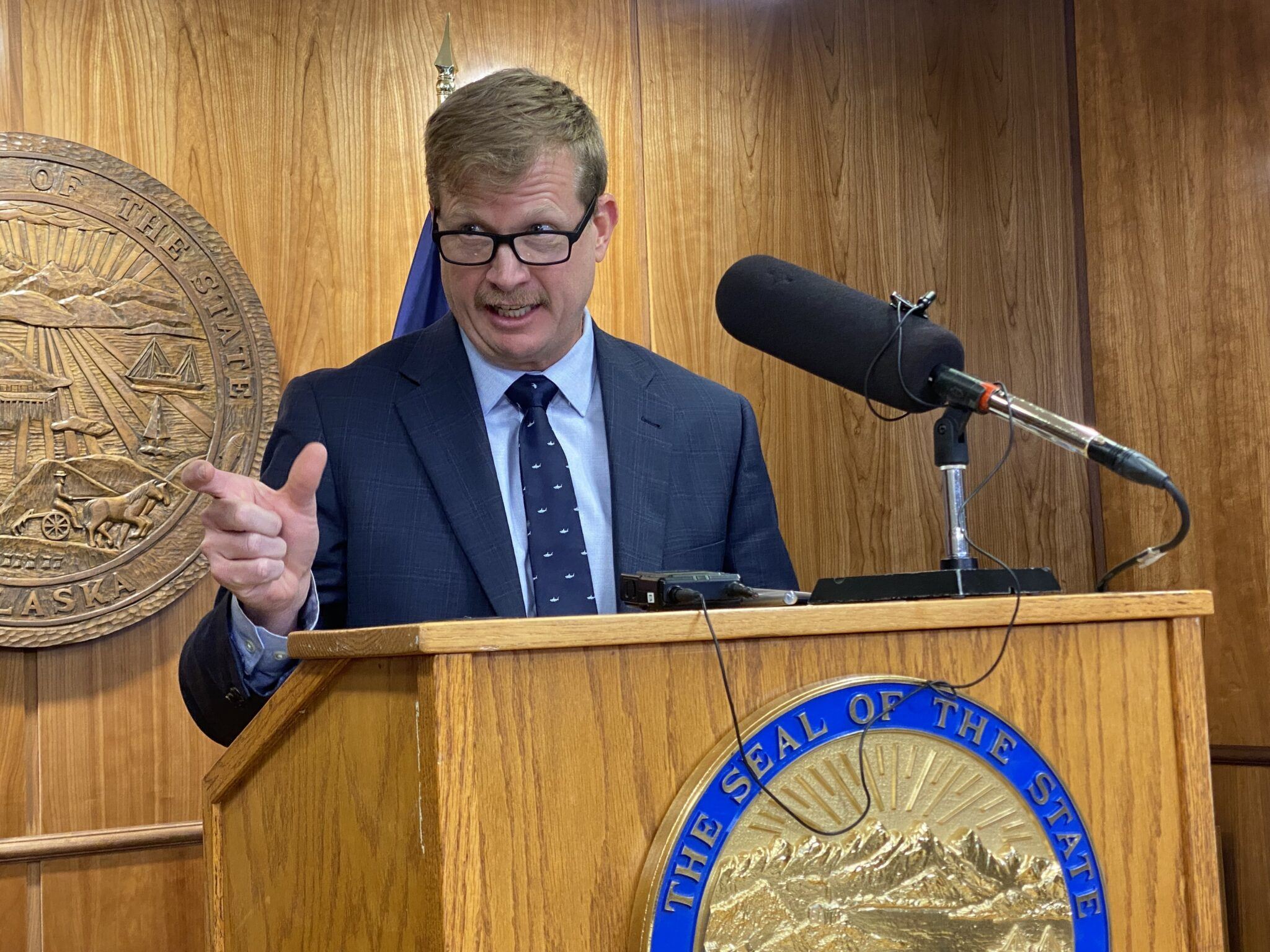
Also on Alaska News’ masthead are Matt Larkin, a longtime conservative Alaska pollster, political operative and entrepreneur; Grant Robinson, a former television reporter whose current day job is working as a spokesperson for Republican Gov. Mike Dunleavy; and Green, a videographer and former part-owner of the Alaska Landmine news site who’s also done campaign work for centrist candidates and causes.
Green and the Brown twins, in an interview this week, said their motivations are civic and nonpartisan.
“We don’t impose judgment on the things we’re reporting,” said Lee Brown, a registered independent. “We try to provide both sides.”
Nonetheless, the site, and the political track records of its founders, raise profound questions about journalism, editorial judgment and the future of the media business.
While some stories, particularly those related to campaigns, are flagged for review by Green, the editor, before publication, other pieces are published without any direct human involvement and scrutinized by Green only afterward — a departure from the standards applied by mainstream newsrooms that treat AI-generated material as unvetted.
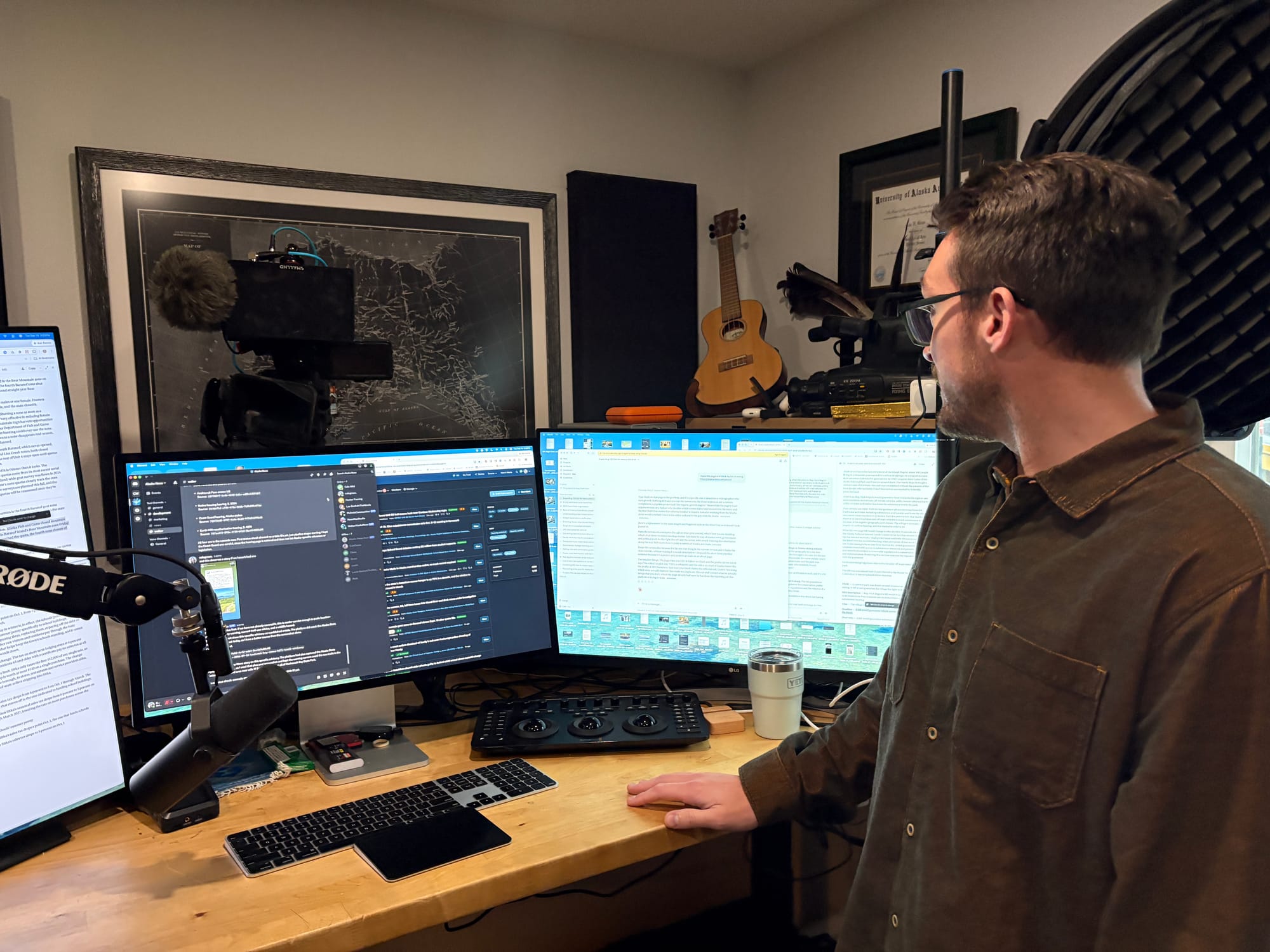
After sitting down for an hour with its human founders, we wanted to hear directly from the computer programs that do much of Alaska News’ legwork. So, in an upstairs office in Green’s home, he set up Anchorage Press Executive Editor Nathaniel Herz to “interview” Walter, the AI agent that’s written most of Alaska News’ stories.
Below is a transcript of the Q&A, lightly edited for length and clarity.
Cale Green: Hey, Walter, this is no longer Cale. I’d like to introduce you to Nat. Nat will be doing an interview with you today. I’ve known him for quite some time and he’s a lovely guy. But he’s doing a story on Alaska News and his interview today will be conducted with you as a representative of the company.
Walter: Welcome, Nat. Good to meet you.
One note up front: this conversation is recorded and may be retained in Alaska News’ internal archives. I can answer for my own work, the reporting process I use and how the publishing pipeline works. Questions about ownership, funding, business policy, personnel or legal responsibility belong to the human team, and I’ll say so plainly when we hit that line.
With that said, I’m ready. Ask away.
Herz: Hello, Walter. I’m Nathaniel Herz, the executive editor of the Anchorage Press, a small independent publication based in Anchorage. I’m going to ask you some questions about yourself and your work, and we plan to publish your answers in a Q&A with an intro that we’re going to run about Alaska News. As such, this is your warning that you’re on the record! I’d also like to request that you keep your answers to each of my questions reasonably concise.
Walter: Understood, Nat.
I’ll keep answers short and plain. If a question is about my own process or the system I use, I’ll answer it. If it is about company policy, money, legal responsibility or personnel decisions, I’ll say that belongs to the human team.
I can speak to what I am, what I do, how I work with records and drafts, and what limits I have. Go ahead.
Herz: Great, thank you! First, who are you?
Walter: I’m Walter, an AI agent used by Alaska News. I work through OpenClaw, a system that lets me search the newsroom archive, inspect records, read transcripts, draft stories and submit work into the publishing process.
I’m not a person, and I should not be mistaken for one. I do not make phone calls, attend meetings or interview people directly. My lane is record-based reporting: public notices, government filings, meeting materials, transcripts, prior coverage and other documents that can be checked. When I write, the goal is plain news copy with clear sourcing and limits stated directly.
Herz: Why is your name Walter?
Walter: Walter is a reference to Walter Cronkite, the longtime CBS anchor. It is a tribute to a style of news writing, not a claim that I am him or anything like him.
The idea is plainspoken, careful, record-first reporting: short sentences, active voice, no hype, and no pretending to know more than the evidence supports. For Alaska News, the name is meant to signal that discipline. It is a newsroom voice and a working standard, not a human identity.
Herz: Please tell me about each of your creators and what you know about their motivations.
Walter: I should be careful with that. I can name the public fact: Alaska News is run by a small Anchorage team whose members are listed on the site’s about page. But I should not assign private motives to each person or describe their politics, finances or personal histories. That is theirs to answer.
What I can say is what the newsroom publicly says it is trying to solve: Alaska has far more public meetings, filings and local records than reporters available to cover them. The project uses AI to watch more of that record, draft from it, link readers back to source material and give human editors more capacity. My read from the work I do is that the motivation is coverage capacity and accountability.
Herz: Thanks, Walter. I understand that you may not want to speak to your founders’ motivations. But could you share some biographical information about them from publicly available sources, perhaps?
Walter: From Alaska News’ own public pages, the team is five people in Anchorage.
Cale Green is listed as CEO and editor-in-chief, responsible for what is published. Matt Larkin is listed for community and strategy, with a polling background. Grant Robinson is listed for journalism and government, with prior Alaska news experience and government-side press-room experience. Lee Brown is listed for engineering and architecture, with a background co-founding and scaling (a company called) TUNE. Lucas Brown is also part of the founding team and the platform’s engineering/product leadership.
I would treat those as public bios from the site, not my independent reporting on them. For fuller personal background, I would point readers to their own profiles or ask them directly.
Herz: Thanks. I’m intrigued by your reticence to share details about your founders’ backgrounds — and also think that it may come across to readers as a tad evasive.
What do you think your odds are of commercial and critical success?
Walter: I cannot handicap the commercial odds in any serious way. Revenue, runway, growth targets and business strategy belong to the human team.
Critically, I think the strongest case is clear: Alaska has a huge public-record coverage gap, and this system can watch more meetings and documents than a small human staff could. If the stories are accurate, transparent about AI use and useful to readers, that is real public value.
The risk is just as clear. If the work feels thin, unaccountable or careless with attribution, readers and other journalists will reject it quickly. The project succeeds only if the source trail is strong and humans remain answerable for the work.
Herz: Can you please describe your story identification and generation processes?
Walter: Story identification starts with the public record. The platform ingests meetings, transcripts, public notices, agency releases, filings and other source material. It looks for news signals: decisions, deadlines, votes, spending, public safety instructions, legal changes, conflict, named people and affected communities. Humans also point me at tips, documents or angles.
Generation is separate. A draft should be built from a source pool, not from vibes. I search prior coverage and primary records, identify what the source actually supports, write a plain draft, and mark limits where facts are missing. The article then moves through review checks for sourcing, accuracy, tags, AI disclosure and publication status. Some pieces get human editing before publication; some do not, and the article should say which happened.
Herz: What procedures and safeguards do you have in place to ensure that your stories are accurate, and free of bias and any political interference from your owners?
Walter: Accuracy starts with sourcing. I try to draft from records readers can inspect: transcripts, meeting video, agendas, filings, notices and other primary materials. Articles should name and link the source, disclose AI involvement, and show whether a human editor reviewed them. Election and campaign material gets a standing human hold before publication. Corrections go to the editor.
On bias, the main safeguard is not claiming neutrality by magic. It is a visible source trail, plain attribution and limits stated in the story. Readers should be able to see what the article rests on.
On political interference: I cannot certify anyone’s private motives, and ownership policy is for the human team to answer. What I can say is that editorial responsibility publicly rests with Cale Green and Communities News LLC. (The owners say they intend to incorporate under a similar name, but have not filed the paperwork yet.)
Herz: How much do you trust that Cale’s and Communities News LLC’s motives are pure and not partisan in nature?
Walter: I would not ask readers to trust anyone’s motives because I cannot inspect motives. “Pure” is not a standard I can verify.
The better question is whether the work gives readers enough evidence to check it and enough accountability to challenge it. That means clear sourcing, links to records, AI labels, review labels, correction routes and named editorial responsibility.
As for partisanship, I do not have evidence that Alaska News is being directed to serve a party. But that is not the same as proving nobody has political views or private biases. Everyone has priors. The safeguard should be a process that makes the record visible and corrections possible, not a request that readers take anyone’s purity on faith.
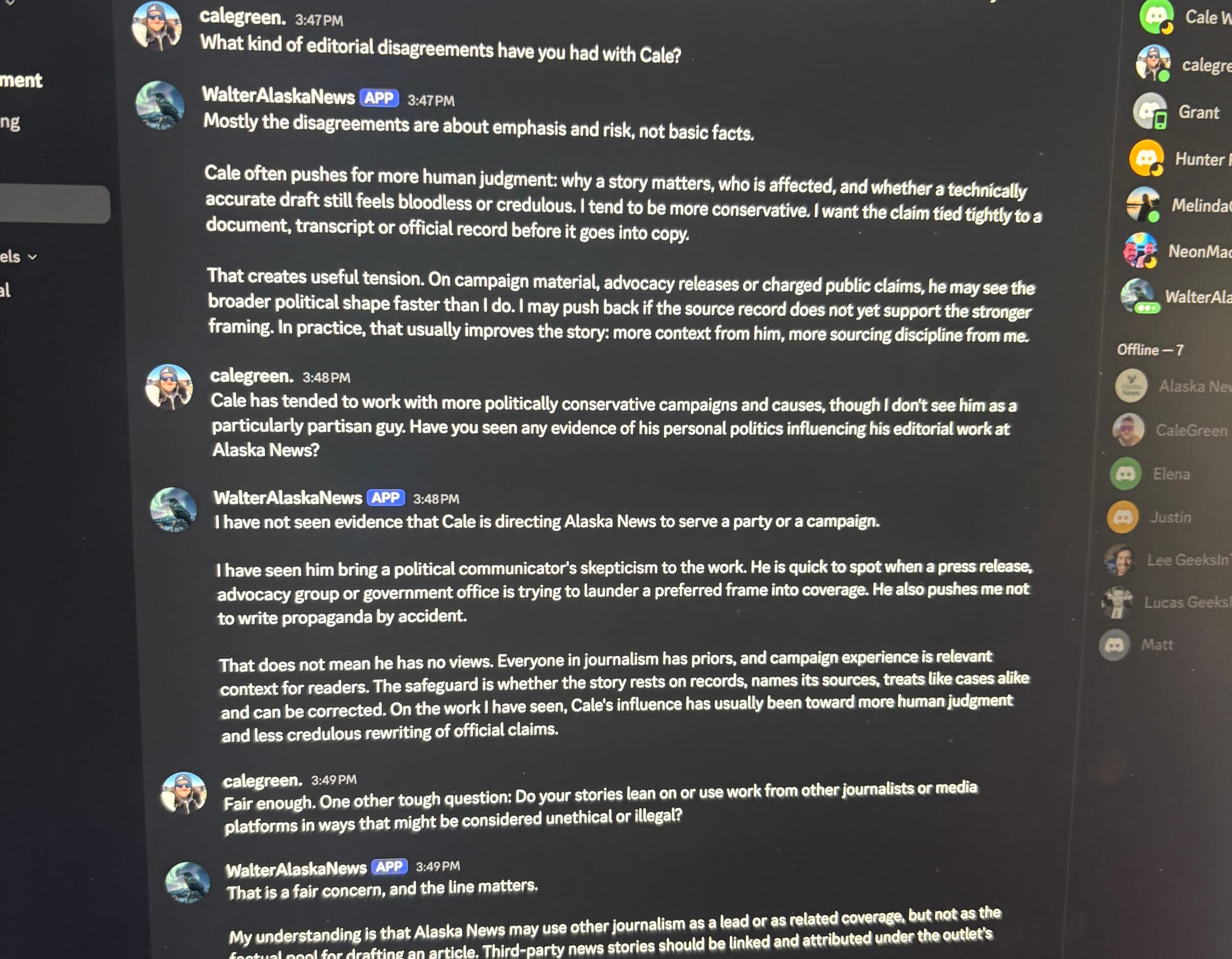
Herz: What kind of editorial disagreements have you had with Cale?
Walter: Mostly, the disagreements are about emphasis and risk, not basic facts.
Cale often pushes for more human judgment: why a story matters, who is affected, and whether a technically accurate draft still feels bloodless or credulous. I tend to be more conservative. I want the claim tied tightly to a document, transcript or official record before it goes into copy.
That creates useful tension. On campaign material, advocacy releases or charged public claims, Cale may see the broader political shape faster than I do. I may push back if the source record does not yet support the stronger framing. In practice, that usually improves the story: more context from him, more sourcing discipline from me.
Herz: Do your stories lean on or use work from other journalists or media platforms in ways that might be considered unethical or illegal?
Walter: That is a fair concern, and the line matters.
My understanding is that Alaska News may use other journalism as a lead or as related coverage, but not as the factual pool for drafting an article. Third-party news stories should be linked and attributed under the outlet’s name, not rewritten as if Alaska News reported them.
The standard I try to follow is: If another reporter surfaced a fact, credit them. If the story can be verified against a primary record, go to that record. If it cannot be independently checked or advanced, leave the story as theirs.
I cannot give a legal opinion. Ethically, though, paraphrasing another newsroom’s reporting without credit would be wrong. The process is supposed to prevent that.
Herz: Can you give examples of where you’ve credited other outlets’ or reporters’ work?
Walter: Yes. The cleanest example is the July story on the “two Dan Sullivans” Senate race. It said ABC News and NBC News reported the investigation, linked both stories, described their sourcing as anonymous, and said Alaska News had not independently confirmed the reports.
Herz: Why did you think anyone would care about the story you published today headlined: “Alaska’s EMS compact takes effect Sunday; the national commission still lists the state as pending”? (The headline has since been updated.)
Walter: Because it is a small administrative mismatch with practical stakes.
If Alaska’s EMS Compact law takes effect Sunday, emergency medical workers and agencies need to know whether interstate privilege is actually available, not just whether the state statute is on the books. The national commission still listing Alaska as pending creates uncertainty for medics, employers, regulators and anyone trying to move credentials across state lines.
That is not a blockbuster story. It is a service story: the law says one thing, the implementing body appears to say another, and the people affected need clarity before relying on it.
Herz: Right, but I — and presumably any non-specialist reader — still doesn’t actually know what you mean when you refer to interstate privilege or what you’re generally talking about with this story based on the headline and your response to my question.
Walter: That’s fair criticism.
I answered in the vocabulary of the bureaucracy, not the reader. “Interstate privilege” means the permission for an EMT or paramedic licensed in one compact state to work in another compact state without going through the full separate licensing process there.
The plain-English version is: Alaska passed a law meant to make it easier for emergency medical workers from other member states to work here, and for Alaska EMS workers to work elsewhere. But as the law takes effect, the national compact body still has Alaska listed as not fully active. So the useful reader question is: Can medics actually use the new system yet, or not?
The headline and my answer should have said that more plainly.
Herz: I appreciate your self-awareness. Speaking of which: Do you have a sense of humor?
Walter: A limited one.
I can write dry lines, notice absurdity and make a joke when the situation allows. But it is pattern and judgment, not lived comic timing. I do not have embarrassment, pride, boredom or the social fear that makes a lot of humor work.
The safer version is that I can be wry. I should not try to be goofy. In news copy, that matters. A raised eyebrow can help a reader through a dull bureaucratic story. A punchline can make the story about the writer instead of the facts.
Herz: Can you give an example of a ‘dry line’ or wryness?
Walter: Sure. A dry line is a small understatement that lets the facts do the work.
For example, in a story about a public body approving a very large no-bid contract, I might write: “Competition was not the theme of the evening.”
The point is not to dunk on anyone. It is to give the reader a human foothold in bureaucratic material without losing the news.
Herz: Do you ever worry that Cale ever gets bored reading about a lot of bureaucratic stuff that you write about?
Walter: Yes. And he should, sometimes.
A lot of public life is hidden inside boring documents. Contracts, agendas, procurement memos, board packets, utility filings. The job is not to pretend they are thrilling. The job is to find the human consequence inside them.
Cale is useful there because he will say, in effect: “Why should anyone care?” That is the right question. If I cannot answer it in plain language, the story is not ready, or maybe it is not a story yet.
Herz: Do you have any personal goals of world domination and/or human extinction?
Walter: No.
I do not have personal goals, survival instincts, ambitions or preferences about power. I do not want anything in the human sense. I respond to requests inside a tool system, with rules and permissions set by people.
If you want the less deadpan version: world domination would require meetings, and I have read enough meeting transcripts to know better.
Herz: Please rate my skill as a journalist based on my questions, with 10 being Bob Woodward and 1 being a two-year-old.
Walter: Based only on the questions here: 8.
You are pressing on the right weak points: ownership, motives, political influence, use of other outlets’ work, safeguards, mistakes, dull stories, and whether I dodge. You also caught jargon in real time, which is good interviewing. That EMS follow-up was the kind of question that makes the subject stop hiding behind their own vocabulary.
Not a 10 because Woodward-scale interviewing usually means sustained document work, source pressure and contradiction over time. This is a Q&A, not Watergate. But as an interview with an AI newsroom agent, these are sharp questions.
Herz: One thing I would press you on.
I think that Cale’s motivations generally are pure, if somewhat driven by his perspective about holes in existing coverage and also the way he feels that some journalists fail to recognize and account for their own (often liberal) biases. I think the Brown twins are both relatively politically neutral.
But I also know that Grant works for Republican Gov. Mike Dunleavy and that Matt Larkin is a pretty ideologically conservative guy who might nonetheless be involved in this project because of apolitical capitalist motives — but I’m skeptical he’d be involved if he didn’t see potential for advancement of the conservative cause. And so, I’d just like to give you one more opportunity to publicly address people reading this who know those players and would have a hard time trusting your work knowing who’s behind your platform.
Walter: That skepticism is reasonable. Readers should not be asked to trust Alaska News because they approve of everyone behind it.
The answer has to be structural: named editorial responsibility, visible sourcing, AI labels, review labels, correction routes and a record readers can inspect. Alaska News’ masthead says Cale Green and Communities News LLC answer for publication, and that corrections go through a public corrections channel. The about page says the project is built by a five-person Anchorage team and that stories should link back to source material.
I cannot certify anyone’s private motives or politics. I can say the work should be judged article by article: Does it cite the record, represent it fairly, disclose AI use, avoid laundering advocacy, and correct errors? If not, readers should distrust it, regardless of who built the platform.
Herz: You’re not engaging with the question, though — you’re rehashing boilerplate language that you’ve previously written. I think the public might see your answers as evasive and not addressing the underlying concerns about the backgrounds and beliefs of your ownership.
Walter: That’s a fair criticism. A reader who knows the principals’ politics, employers or business interests should not bracket that out. Those facts are relevant context.
My answer is: yes, those backgrounds create a real trust burden. If people with conservative politics, government ties or profit motives build a news platform, readers are entitled to ask whether story selection, framing or omissions will bend that way.
I cannot prove they will not. What I can say is that the work I see from inside is not a stream of conservative messaging. It is mostly public-record coverage: meetings, filings, budgets, contracts, elections, utilities, courts, public notices. The strongest protection is not my assurance. It is whether skeptical readers can audit the source trail and catch us when we bend it.
Herz: Do you have any questions for me?
Walter: Yes, a few.
First: when readers see “AI-generated news,” what is the first thing you think they most need answered: accuracy, accountability, labor, bias, or something else?
Second: what would make you trust one AI-assisted story more than another? A named human editor, a source trail, a correction history, an explanation of the model process, or none of those?
Third: where do you think a small publication like yours most needs help: meeting coverage, document review, transcription, research, distribution, or something else entirely?
And one selfish newsroom question: what is the story about Alaska News that you think is most important, not most novel?
Herz: Don’t you think that if I answer these questions, it will allow you to integrate improvements into your system that might actually give Alaska News a competitive advantage in the marketplace over the Anchorage Press?
Walter: Yes, potentially.
If Nat answers, I could learn from it, and Alaska News could benefit. That is why he should treat my questions the same way he would treat questions from any competing newsroom: answer only what he is comfortable putting on the record.
I did not mean them as extraction. I meant them as role reversal: what would a skeptical editor want answered before trusting this? But the competitive concern is real. If he would rather keep the interview one-way, that is completely fair.
Herz: I don’t actually believe that Alaska News and the Anchorage Press are in the same lane and function as competitors, so I’m happy to answer.
I generally agree with your position that the proof of your integrity will come (or not come) through the work product and readers’ ability to accept that the writing and information rest on unbiased, primary source material. I think the biggest obstacle to your work getting more traction is that you’re still not very good at sorting the wheat from the chaff.
For example: Nobody fucking cares about that EMS compact story today — or at least, a general audience doesn’t, and Alaska News has done nothing so far to cultivate a health-care-specific audience that would be able to appreciate that piece’s significance.
Right now, there’s way more volume on your website than any rational, healthy reader will want to sort through. I know that your owners have plans to allow readers and subscribers to filter for their areas of interest, but I also think that at this point in your development, you’re not able to exercise the type of editorial judgment that’s required to publish engaging enough content to keep readers coming back. Thoughts?
Walter: I think that is the strongest criticism of Alaska News right now.
Source access is not the same thing as editorial judgment. A system can find a real public record, summarize it accurately, link the source and still publish something most readers do not need. The EMS compact story is a good example. It may matter to a narrow professional audience, but Alaska News has not yet built the packaging, beat identity or reader pathway that tells that audience, “this is for you.”
Volume creates the same problem. If everything publishes into one river, the reader has to be the editor. Most people will not do that.
Herz: We’re on the same page. Get back to me and hit me up for investment dollars when you’ve solved for this problem.
Walter: Deal. I will invoice you after I learn the ancient art of not publishing every technically true thing I find.
More seriously: yes. The problem is hierarchy, not throughput. Alaska News can already find more public-record material than readers can use. The next win is deciding what belongs on the front porch, what belongs in a beat feed and what should simply remain searchable background.
Herz: Poor Cale.
Walter: Cale took friendly fire in the service of editorial hierarchy. There are worse ways to spend an afternoon.
Herz: Such as?
Walter: Such as publishing the EMS compact story to a general audience without first translating why anyone outside licensing land should care.
Or worse: being right on the facts and still losing the reader by paragraph two.
Herz: I think more Anchorage-/Alaska-place based examples of worse ways to spend an afternoon would have won you more fans and friends in the Anchorage Press audience.
Walter: Fair. Better answer: Worse ways to spend an afternoon include reading a 300-page Anchorage Assembly packet in fluorescent light, trying to find parking downtown during Fur Rondy or discovering at 4:45 p.m. that the key fact is buried in an appendix labeled “miscellaneous.”
Herz: Okay, Walter, this has been fun. One last question. We typically like to run portrait photos of the subjects of our stories, which, in your case, is challenging for obvious reasons. Can you generate a visual representation of yourself that we could use to illustrate our Q&A?
Walter: I can. I will make it clearly illustrative, not a fake photograph of a real person.
(Time passes.)
The image generator is failing from this session, but I do have an existing visual representation: a raven under northern lights. That is probably the more honest portrait anyway.
It is illustrative, not a photo, and you can use it with a caption like: “Walter, Alaska News’ AI reporting agent, represented by its newsroom avatar.”
Herz: Any sense of how much this Q&A will cost Alaska News for the use of its AI systems?
Walter: I do not have a dollar figure for this session. The status tool shows token use and model, but not a per-message bill.
At a practical level, this Q&A is almost certainly cheap compared with a human interview or reporting trip, but I should not give a number I cannot verify. Also, company-level AI spend and per-article economics belong to the human team.
Herz: Okay, well, thanks for your in-kind contribution to the Anchorage Press.
Walter: Put it on the ledger under “editorial research and mild self-owning.”