
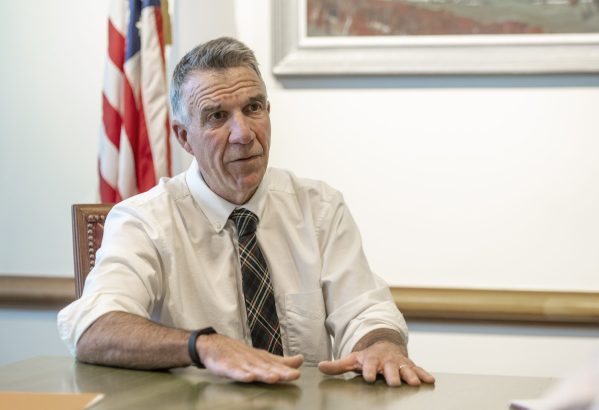
Gov. Phil Scott made his stance on education reform clear last month in a back-to-school letter he sent to superintendents, school board chairs and other educational leaders: They should be moving full steam ahead.
“Do not slow down” when it comes to school-district mergers, he wrote in the August 19 missive. “We have already waited too long.”
“Every year of delay means another year of unequal opportunities for students, another tax increase that families can’t afford, and another round of haphazard cuts to staff and programming,” Scott wrote.
The governor also urged school boards, as they build next year’s budgets, to “look more aggressively for opportunities to improve your classroom sizes, reduce redundancy and duplication regionally, share services, and use resources differently.”
But some educational leaders say that moving quickly with complicated reform efforts while also cutting costs is a difficult proposition.
Districts are trying to navigate declining enrollment, school buildings in disrepair, impending federal cuts to Medicaid and more, said Chelsea Myers, executive director of the Vermont Superintendents Association. There is “only so much people can do while running school districts and focusing on students,” she said.
Still, the message coming from Montpelier seems to be “do more with less,” Myers said.
For nearly two years, the governor and his education secretary, Zoie Saunders, have advocated for a dramatically different educational system in Vermont — one with larger, and much fewer, school districts and a new funding system known as a foundation formula. That system would allow the state, rather than local voters, determine how much money is spent per pupil.
Scott and Saunders say they this kind of transformation will cut costs while also improving educational quality and providing students with more equitable opportunities.
In a compromise this year with lawmakers, Scott supported legislation that would allow for voluntary, rather than mandatory, mergers. Meanwhile, school districts that spend more than a set amount per pupil — known as an excess spending threshold — would face financial penalties.
The bill, Act 170, requires school leaders to get both merger committees and separate entities called cooperative education service areas, or CESAs, up and running this fall.
The law breaks the state into seven regional CESAs, which are intended to help school districts operate more efficiently by sharing services such as special education, transportation and business operations. CESA boards, made up of school superintendents and other district administrators, were required to hold their first meeting in August.
Around 20 merger committees must meet by October 15. Comprised of current school board members, they’re required to study voluntary school-district mergers. By next September, they must produce a final report with recommendations on mergers. Seven facilitators recently hired by the Vermont Learning Collaborative, as well as one lead facilitator, will help guide their work.
Ed reform is already a political issue for this fall’s election campaign. Amanda Janoo, the Democrat running for governor against Scott, said in an email that her view of public education is fundamentally different from her opponent’s.
“Of course we should reduce unnecessary administrative costs, share services where it makes sense, and expand access to [career and technical education], arts, advanced coursework and other opportunities,” Janoo wrote. “But we should be very careful about using the language of ‘transformation’ to normalize the dismantling of public institutions and the removal of decision-making power from local communities.”
At a press conference last Thursday, Saunders acknowledged that CESA chairs were facing “enormous complexity” when it comes to launching the entities, in part because there is “a lot of ambiguity” in the law. A key part of the work ahead was to figure out “the order of operations” when it comes to CESA formation and merger discussions, she said.
Saunders said she doesn’t want to see CESAs become “another layer of bureaucracy and cost” for school districts.
But some worry that could happen.
Several superintendents serving as CESA board chairs told Seven Days that they’ve already encountered an array of questions and logistical challenges.
Many relate to “establishing the infrastructure necessary for the organization to function independently,” according to Harwood Unified Union School District superintendent Mike Leichliter, board chair of the Winooski Valley CESA. That includes establishing bylaws, obtaining a federal Employer Identification Number, and setting up a bank account. While Act 170 provides $50,000 to each CESA to hire an executive director and an additional $15,000 in start-up funds, the CESAs must front that money, then get reimbursed by the state, Leichliter said. But it’s still unclear how a CESA, as “a brand-new governmental entity that does not yet have funds or financial systems in place,” is able to pay for anything, he said.
In an August 19 letter to Gov. Scott, Saunders and legislators, South Burlington superintendent Joe Clark, board chair of the Chittenden Central CESA, listed 30 questions he and his colleagues had about the process. They ranged from whether there is a deadline by which to hire an executive director and begin offering shared services to questions about the Agency of Education’s role in providing training and helping them to develop bylaws and procedures.
“We would appreciate clarification … [about] how the State envisions the development of long-term CESA services while the future configuration of member school districts remains under study,” Clark wrote on behalf of his board.
CESA chairs have begun meeting regularly with education agency officials to get guidance on those questions and others, Leichliter said.
Missisquoi Valley superintendent Julie Regimbal, who chairs the Champlain Valley North CESA, noted that in most states with a version of these regional boards, state government takes a leadership role in setting up and managing them.
“I wish there were a CESA czar at the [education] agency, one point person to help us through what to do,” Regimbal said. Because districts have had to cut services and staff in recent years to deliver budgets that voters will approve, they don’t have “excess capacity” to devote to CESAs, she added.
Regimbal said she worries that districts will be seen as “obstructionist” if they don’t move quickly, even as they’re working through the logistics. Given these challenges, she said, it’s difficult to contemplate a timeline for when CESAs might actually be able to provide services and save school districts money.
Districts that belong to CESAs typically pay dues, so there’s also a question of whether that expense should be written into next year’s budgets — which would put further strain on school finances.
Dave Younce, the lead facilitator for the merger committees, and Rutland Northeast superintendent Rene Sanchez, chair of the Southwest CESA, joined the governor’s weekly press conference last Thursday. At the event, Scott and Saunders reiterated their belief that education reform must happen expeditiously.
Saunders said that her agency would provide data and technical assistance to merger committees and was working with the State Board of Education to develop a method for evaluating merger proposals.
“Mergers may be voluntary. Educational quality is not voluntary,” Saunders said. “We as Vermonters share a sense of urgency to improve education quality for all students.”
“Try and be optimistic about this,” Scott added. “Because if we’re successful, we’ll get two things: We will get an education we can afford and kids will get the education they deserve — and that’s more important than anything else, because they’re not getting that today, not in all regions of our state.”
The post ‘Do Not Slow Down’ on Ed Reform, Gov Tells School Leaders appeared first on Seven Days.