
Hours after the Festival for the Eno wrapped up last July, Tropical Storm Chantal delivered record rainfall, flooding the Eno River and its surrounding communities. Entire neighborhoods saw lasting flood damage and the festival’s home at West Point on the Eno had its facilities submerged.
And amid rising summer temperatures, leadership at the Eno River Association (ERA)—which has put on the festival since 1980—say they’ve had to recalculate what future iterations of the festival will look like.
With accessibility construction still underway at West Point on the Eno, this year’s festival is shifting from its usual July dates and river bank location to downtown Durham. On September 12 at the Durham Convention Center Plaza, community members will find live performances and a craft workshop from 1 to 5 p.m., followed by a 7:30 p.m. benefit concert at the Carolina Theatre.
“We’re not trying to be the festival in its traditional sense,” said H.C. McEntire, who is the Store and Event Manager at ERA and leading the event for the first time. “With our bandwidth, we’re trying to put on a celebration and a fundraiser that feels authentic and that also honors this decision we made to pivot from a July 4 middle-of-summer situation.”
The festival will permanently move to the spring after this year, executive director Ryan Fehrman said. The construction at West Point on the Eno is scheduled to finish by early 2027, and the festival will return to its usual location by the river. Fehrman said the ERA is also planning on continuing to host a fall benefit concert as part of a dual-season model for the festival.
The change in season for the festival comes in response to extreme heat and weather in the summer. This year on July 4, temperatures soared above 100 degrees and air quality warnings were issued as the Triangle saw its worst drought in a decade.
“The environment is flashing a red light at the world, that climate change is real,” Fehrman said. “I think what’s important for agencies like ours—and for people like me that are leading—is we don’t just talk about these things, we have to adjust and recalibrate and do things a little bit differently.”
Puppets and crafts
The festival usually draws about 20,000 people over two days, with four stages, food and craft vendors, and hundreds of volunteers. But due to space constraints at DPlex Plaza this year, the celebration will be entirely run by staff and there won’t be vendors.
“We didn’t want to play favorites,” McEntire said. She said she hopes the festival’s location downtown will instead encourage attendees to walk around to local businesses.
The free daytime plaza celebration includes live performances from the Paperhand Puppet Intervention, the Durham Labor Choir, musical group Duo d’Antan, and string band Five Points Rounders accompanying a square dance.
The Scrap Exchange is hosting a craft station alongside a kazoo workshop, where participants can make their own kazoo from repurposed materials. Durham artist Serindib Creative will be painting a live mural, and attendees can purchase ERA merchandise.
In the evening, the Carolina Theatre will host artists Pura Fé and Cary Morin, Jake Xerxes Fussell, and Tre. Charles, in addition to poetry performances from Beverly Scarlett, Cortland Gilliam, and Brian Howe. Tickets can be purchased online starting at $40. All proceeds go to support the ERA as it celebrates its 60th anniversary.
For this performance, Pura Fé is returning home to North Carolina from where she’s now based in Saskatchewan, Canada. An indigenous songwriter and storyteller, Pura Fé is the ninth generation of female singers in her family who come from the Tuscarora Blackman/Blackwell line—also called the Deer Clan—in North Carolina.
When she lived in Durham, Pura Fé said she walked on the Eno every morning.
“The riverways, the waterways—our ancestral waterways—are our bloodlines,” Pura Fe said. “Those are our genealogical trees, the rivers.”
Pura Fe sings in a variety of native languages in addition to English, blending traditional indigenous music types with blues. She said her family of musicians has influenced her songwriting, and she will be performing pieces on her own as well as with collaborator Cary Morin, who is also an indigenous artist.
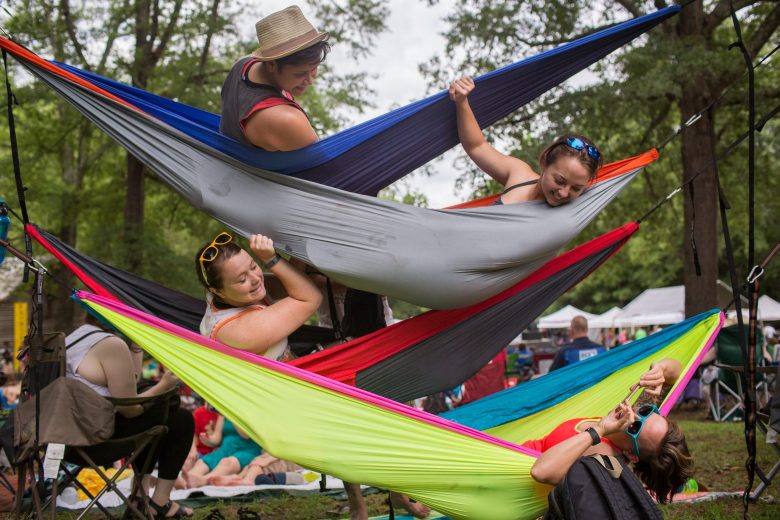
“A positive vision”
This is the first benefit concert of its kind, and McEntire said it was important that the ERA celebrates its 60 years and honor the people who started the organization, even if in a different way than in years past.
“It’s a powerful river and a powerful place, and it does impact everyone around it,” McEntire said. “We’re lucky, but we also have an immense responsibility to continue this conservation legacy.”
The ERA is in its second year of new leadership, with Fehrman having come on as executive director in 2025. The association has had a bumpy few years—In 2022, the nonprofit tried to evict tenants from homes it owned along Open Air Camp Road to sell the land to the state. Tenants organized and pushed back, and by 2023 the ERA reversed course, agreeing to preserve the homes as permanently affordable housing instead.
Fehrman said the organization’s experience with Open Air Camp was “painful,” and that the ERA took the necessary financial loss to make things right. He said while he wasn’t leading the organization during that time, he feels it’s his responsibility to repair relationships with the community.
“I want to create an inclusive and welcoming environment where every single person feels welcome at the Eno River, at our preserves, at the state park, and at West Point,” Fehrman said. “It shouldn’t matter what your skin color is, it shouldn’t matter your gender or your sexual orientation. This should be a safe and welcoming space for the entire community.”
The Open Air Camp sale to a community home trust—for $1 a piece—put a dip in the organization’s finances, with expenses outpacing revenue in 2023. The nonprofit is now bouncing back, according to 2025 financial reports.
Most years the festival generates a small profit, but when the weather is bad, the festival loses money, Fehrman said, adding that he hopes that moving the festival to the spring will support the financial health of the event, alongside making things easier on attendees.
“People are craving a positive vision right now,” Fehrman said.
To comment on this story, email [email protected].