
From the editors:
If you’ve seen our October print issue, you already know that the Press published a special section on the annual Alaska Federation of Natives and First Alaskans Institute’s Elders & Youth conventions. This week, as those conventions unfold, we’re publishing pieces from the special section online.
We’re excited to share these stories, which were commissioned in partnership with two guest editors, Dewey Kk’ołeyo Putyuk Hoffman and Melissa Nenantaxnen Shaginoff — the latter of whom wrote this piece. The Press also has a table at the Elders & Youth convention and we’ll be present at AFN, as well, so stop by and say hi and/or pull us aside to share your feedback, suggestions, and story ideas and pitches.
As an Ahtna woman, I have been taught that wherever I go in Alaska, my ancestors, and the ancestors of all Alaska Native people, have already been.
Anchorage, Dghayitnu, Dgheyaytnu is Dena’ina homeland. We know this by measuring everything we love about Dghayitnu against the evidence of Indigenous existence here — the health of the land and animals, the expansiveness of their language, the thousands of place names shared from the memories of Dena’ina Elders.
But is this something that all of us who call Dghayitnu home know? Do settlers, visitors, and other Alaska Native peoples recognize Dena’ina culture when they see it?
In recent years, place-naming movements, public art installations, and language revitalization efforts have increasingly put Dena’ina culture in front of people in Dghayitnu. Yet visibility and common understanding remains uneven, and far from complete.
An effort by the Alaska Native Heritage Center to strengthen Dena’ina visibility is its new exhibition Dena’ina Quht’ana, or “local Dena’ina.”
It is a permanent exhibition that features rotating Dena’ina cultural belongings on loan from art collections around the world — some of which have not been viewed by Dena’ina people in nearly a century.
“We wanted to address that a lot of the time, Dena’ina culture can feel somewhat ambiguous,” Ben Jacuk, the heritage center’s Indigenous research and healing director, shared. “This exhibition gives us an opportunity to celebrate the people from this area. Through belongings like the kayak bow, the quivers, and the gut parkas, we see these things that are undoubtedly Dena’ina…particularly, the experience of being the only Dene people who live on the saltwater.”
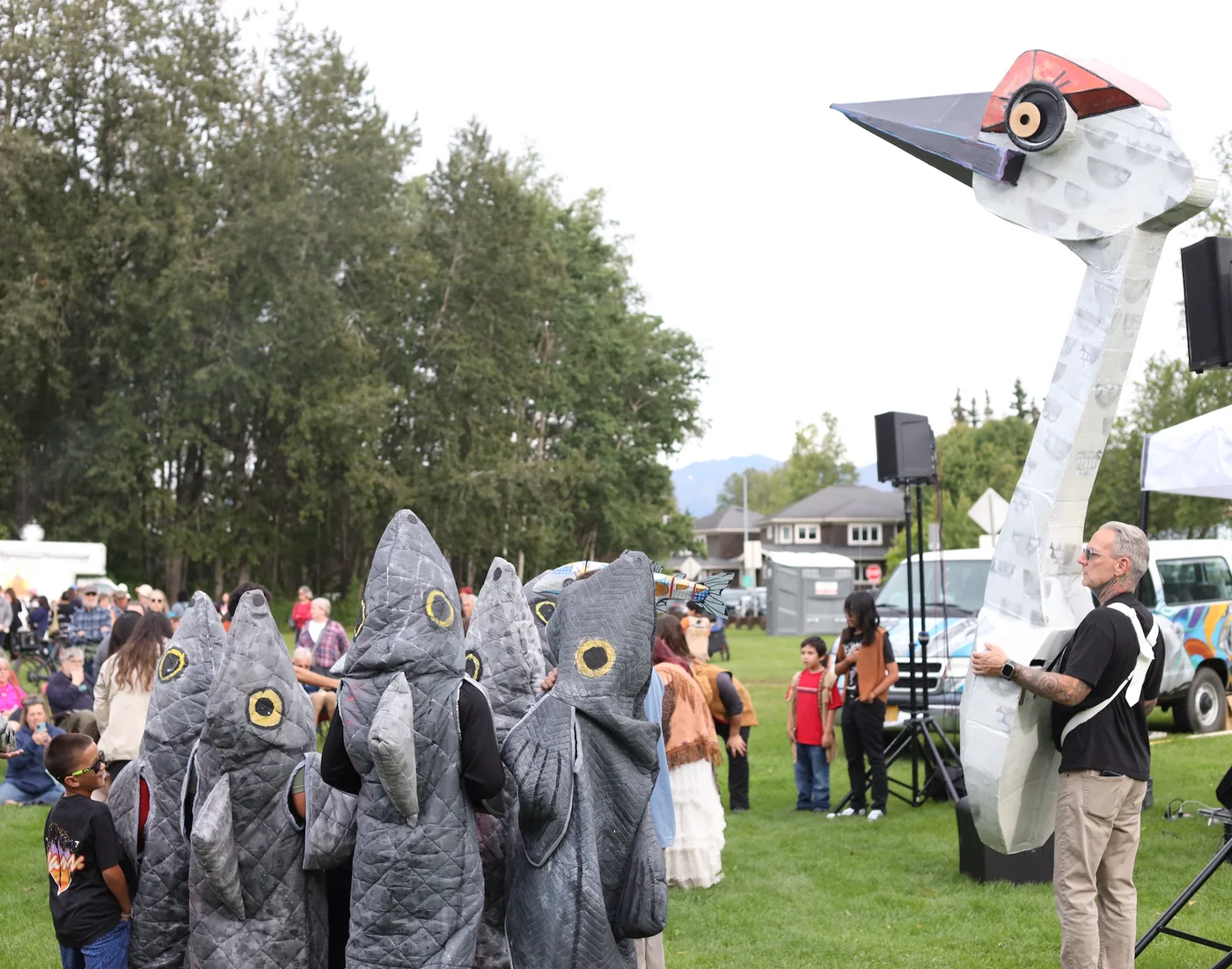
Ch’atanaltsegh: A weird and wonderful parade marks return of a Dena’ina place name in Anchorage
Larger-than-life salmon and sandhill cranes joined Indigenous dancers near Fish Creek, just west of downtown.
The new exhibition represents an incremental step toward repairing the erasure and destruction of Dena’ina presence that accompanied the rapid colonization of Dghayitnu. One notable and painful story was the burning of the Dena’ina fish camps in Dgheyay kaq’, the mouth of Ship Creek, which became the original townsite of Anchorage.
Some of the cultural belongings on display at the heritage center capture the connectedness, uniqueness and ingenuity of Dena’ina people that were common before the era of assimilation.
A kayak bow — a family heirloom on loan from Dena’ina Elder Marilyn Balluta, who also translated the exhibition title — reflects the knowledge-sharing the Dena’ina people practiced with their cultural neighbors, a point many academic interpretations of Dena’ina collections tend to miss.
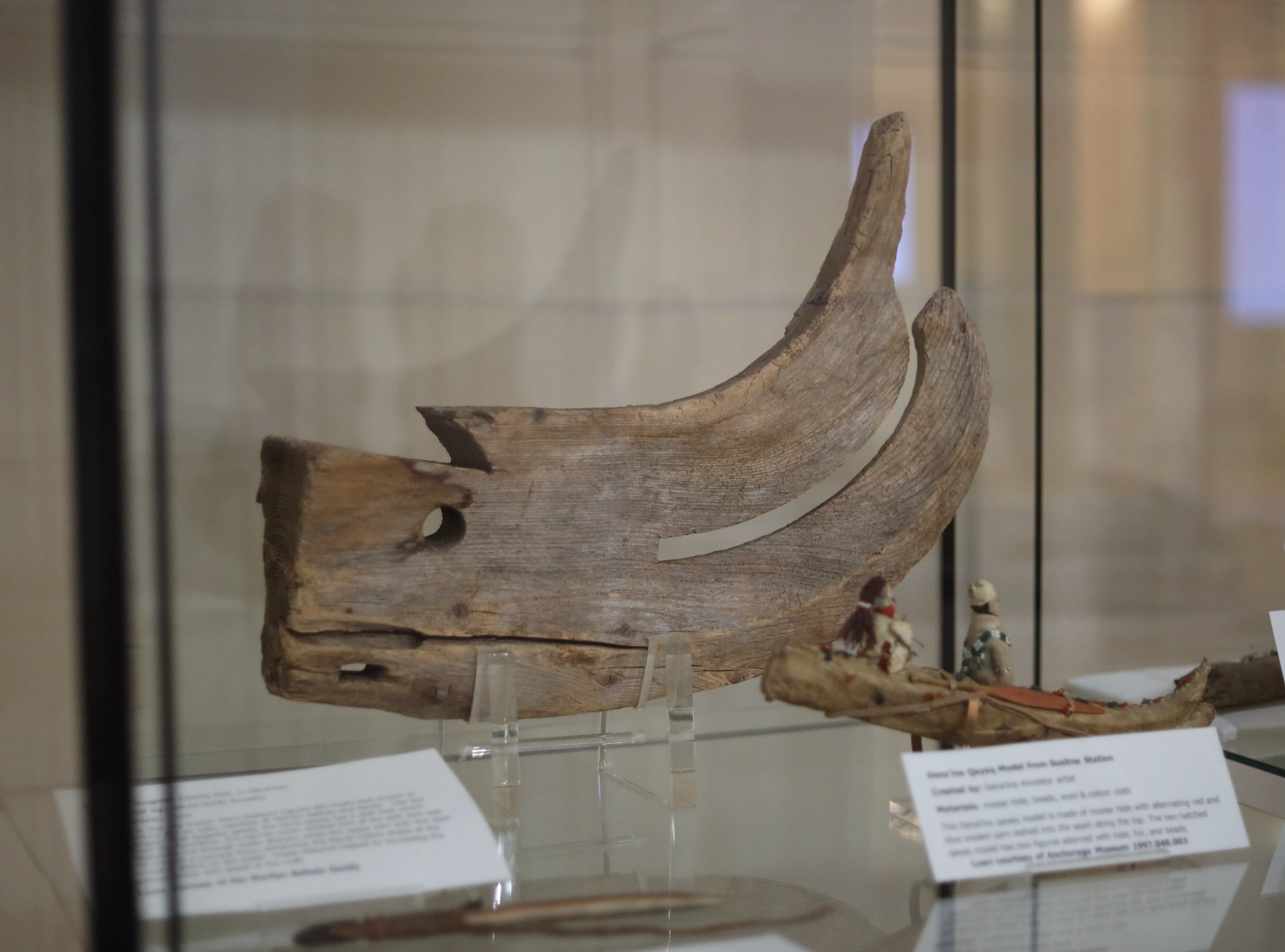
Its design, a double bow, appears in kayaks of other seafaring Alaska Native people throughout Tikahtnu, or Cook Inlet. It was created to break through rough waters when hunting sea mammals and represents the shared technologies between cultures — whether through intermarriage, trade, or simply sharing kayak-building tips. The kayak bow shows that the Dena’ina have a long shared knowledge across great distances, even across the sea, and this exhibition continues that tradition.
Two caribou‑hide quivers, on loan from the Kenaitze Indian Tribe, are also shown.
These quivers, which held arrows used for hunting, were returned to the tribe from the Ralph T. Coe Center in New Mexico, which is where I first saw them, as a college student.
When the Coe Center announced its closure, I knew the Kenaitze Tribe needed to request their return.
These quivers are especially specific to the Dena’ina people from the Kenai Peninsula, where I grew up. One of them has an ochre-painted scene of caribou hunting and, uniquely, the three volcanoes surrounding the Kenai: Mount Redoubt, Mount Iliamna, and Mount Spurr.
The quivers serve another purpose in the exhibition: As the heritage center rotates the belongings on display, it is also hosting art-making workshops, where cultural knowledge holders teach students how to recreate the fundamental aspects of Dena’ina aesthetics found in their ancestral material culture.
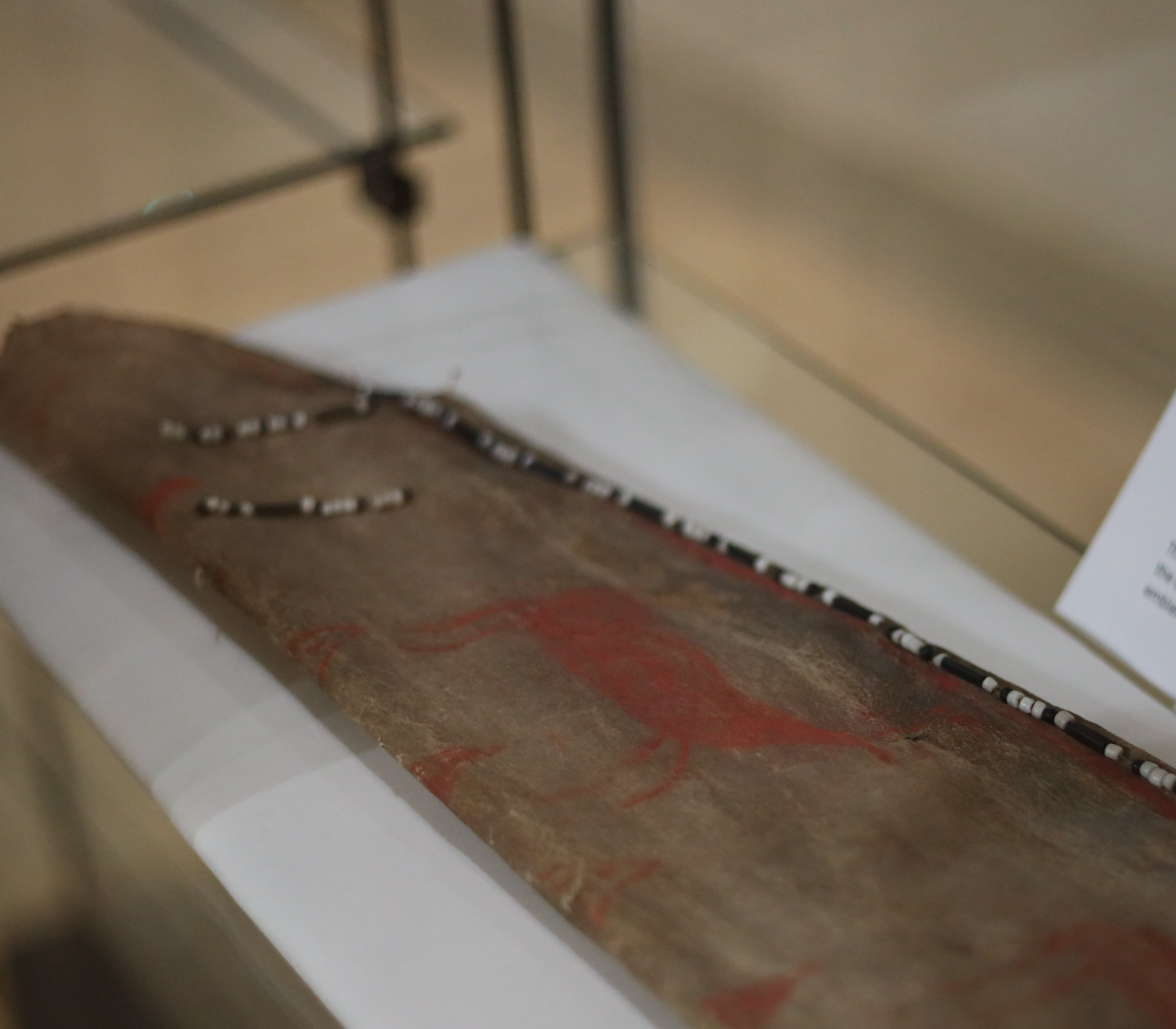
The ochre painting and porcupine quill weaving on the quivers also challenge longstanding assumptions about local Indigenous aesthetics — that they’re “just floral beadwork,” said Aaron Leggett, president of the Native Village of Eklutna.
“For me, that thought is challenging because it isn’t exactly who we were, not fully. We were much more abstract,” said Leggett, who’s also a senior curator of Alaska history and Indigenous culture at the Anchorage Museum.
Over Leggett’s career, he said, he’s located a number of Dena’ina quivers — but they’ve been found mostly in Europe, far from where they were created.
“I am just blown away that two are now at the heritage center, and that they have the quillwork and ochre,” he said.
The most recent loan on display is from Yale University’s Peabody Museum: a kayak skirt and two gut parkas — waterproof jackets made from sea mammal intestine.
Anthropologist Cornelius Osgood collected these in the Tikahtnu area and brought them to Yale in the 1930s, and the gut parkas are among the oldest positively identified Dena’ina collections in the United States.
The belongings will be with the heritage center for three years thanks to an agreement between the two museums, giving Alaska Native museum professionals in Dghayitnu a chance to develop their skills with help from a local conservator, Sarah Jane Owens.
“An important aspect of bringing these parkas here is so that Native people, from here, could do the work of conservation and care,” said Angie Demma, the heritage center’s collection director.
This partnership represents the future of museum work and a shift from the past — when Indigenous people weren’t always trusted in their intentions and given the opportunity to learn from, care for, and decide the future of their own cultural belongings.
Dena’ina Quht’ana is challenging our collective idea of what a museum exhibition is. This exhibition is purposeful and activating. It invites visitors, students, and new museum professionals to learn the fundamental elements of Dena’ina aesthetics. It includes heirloom belongings that hold our families’ stories; it offers our community the opportunity to learn art‑making techniques not currently practiced; and it honors us with the chance to care for belongings that have been away from their homeland for far too long.
Aaron recalled reading an interview with the late Elder Clare Swan. “When asked what it means to be Dena’ina, she said: It feels like we are the invisible people. We are invisible to outsiders; we’ll become invisible to ourselves.”
This exhibition works against that invisibility. It brings Dena’ina presence forward, making it visible, tangible, and undeniable in the place where Dena’ina people have always lived, and will always live.
The Anchorage Press is a reader-driven publication. If you’re already a subscriber, we’re grateful for your support; if you’re not, $130 will buy you our undying gratitude AND a hard copy of the Press in the mail each month!