
WELLS — Abrielle Remick opened the chest freezer in Webhannet River Boat Yard to find 10 striped bass, filleted and frozen. Each one was packed in a plastic bag with a paper tag that identified the person who hooked the fish, as well as the date and location of the catch.
After she and two teammates filled two coolers in the back of their truck with fish, Remick checked one tag and read the name aloud: “Spencer.”
“We always have different, new names around here,” Remick said.
Remick is a master’s student at the University of Maine, and this summer is her second studying the diets of Atlantic striped bass. The migratory species primarily spawns in the Chesapeake Bay in Maryland and comes to Maine at this time of year to feed.
“That fuels them for their migration south, for their overwintering period,” Remick said. “What they’re eating up here definitely impacts their survival and their success in the subsequent spawning period.”
Researchers have done diet studies on striped bass in other parts of the Atlantic coast, but Remick said there has never been a comprehensive study of what they eat in the Gulf of Maine. With encouragement from her advisor in the School of Marine Sciences at UMaine, Remick decided to try to fill that gap.
Most of her data comes from the guts of fish donated by anglers, and the Webhannet River Boat Yard is one of the drop-off sites for those wishing to contribute to her research. She has found that anglers are eager to participate in the science.
“Part of the reason we partnered with Abby is because the fishery is in trouble,” Ben Anderson, manager of the tackle shop at Webhannet River Boat Yard, said.
The Atlantic States Marine Fisheries oversees this species and has declared it overfished. Maine doesn’t allow commercial fishing of striped bass and has rules in place for recreational fishing of the species. Anglers can only keep one per day, for instance, and it must be between 28 and 31 inches.
Anderson said people are seeing a lot of big stripers but not as many small ones, a warning sign for the future of the stock.
“Seeing a lot of big fish is fun,” Anderson said. “It’s not a good thing.”
REELING IN THE DATA
On Tuesday, Remick was up at 3 a.m. to make the trip from Darling Marine Center in Walpole, where UMaine marine sciences professor Michelle Staudinger runs a lab, to the boatyard in Wells. Remick and two other students met a charter captain there at dawn and headed out to sea.
Remick gathers data in two ways.
Charter captains and anglers volunteer to take her out to look for striped bass. When they catch one, Remick flushes their stomachs and then returns them safely to the water. On Tuesday, she successfully sampled two stripers before the captain had to return to pick up clients for the day.
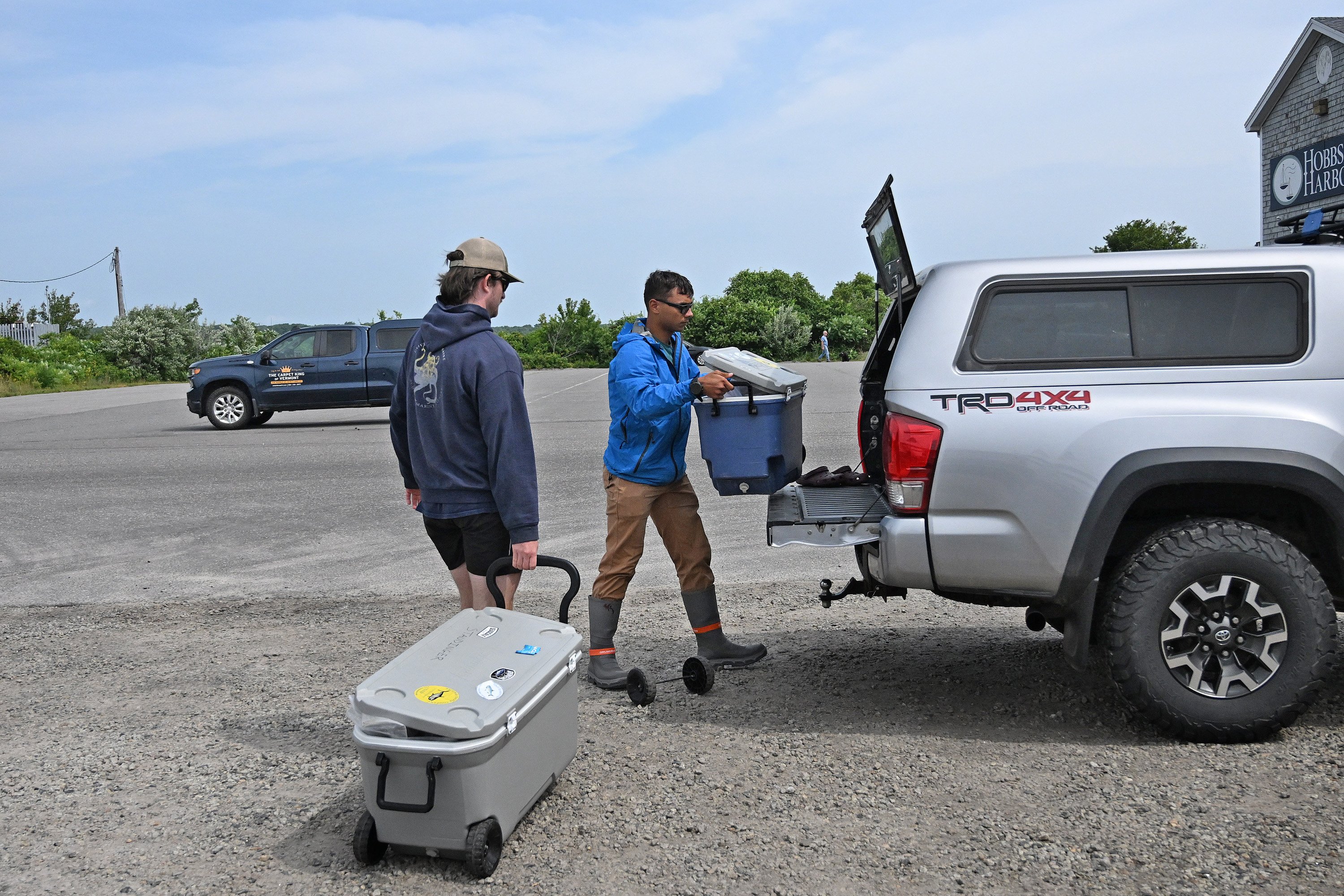
Remick also accepts donations of filleted fish carcasses and opens their stomachs in her lab to see what’s inside. She has partnered with three tackle shops — Webhannet River Boat Yard in Wells, Saco Bay Tackle in Saco and Fishermen’s Edge in Edgecomb — that keep freezer space for anglers to drop their catch. Sometimes, she gets texts about available fish and coordinates pickup from individual anglers.
When she got back to land on Tuesday, she picked up the latest donations from the boatyard’s freezer to bring back to the lab.
In 2025, the first year of the study, she sampled 287 fish between May and October. More than 60% — 178 — came from donations. Remick credited the recreational fishing community, tackle shops and charter captains for her progress.
“I didn’t really know how to fish for striped bass two years ago,” Remick said. “I just jumped into this project and have learned so much and would probably have a sample size of 15 if it was up to just me.”
Remick said her findings so far are based only on one year of data and should be considered preliminary. She’s seeing variation based on habitat and time of year. Striped bass in the coastal rivers are eating a lot of green crabs, for example, while those farther off the coast are getting sand eels, mackerel, herring and menhaden. Some fish seem to be eating small lobsters but in very low numbers, a data point that Remick said is important for the state’s commercial fishery.
“They’re going to get more bang for their buck on the fish species that are a lot fattier and have just more nutritional content,” she said.
‘CANARIES IN THE COAL MINE’
One person eager to see the findings is Matthew Cieri, a marine resource scientist who works for the state and is also involved in ecosystem modeling for the Atlantic States Marine Fisheries Commission.
Fisheries managers use ecosystem monitoring to inform regulations, Cieri said, and diet studies like this one give them critical data about both predators and prey.
“This isn’t going to sit on a shelf someplace,” Cieri said. “This is immediately going to be emailed to me and to the rest of a group of scientists. We’re going to use it in our next model.”
Remick said she expects to complete her field research this year. If the work continues in the future, Cieri said it could also provide important information about how climate change and warming oceans are impacting species in the Gulf of Maine.
“Striped bass and other coastal predators can be canaries in the coal mine as far as ecosystem changes,” Cieri said.
For more information about the study, including contact information and drop-off locations for donations, visit umaine.edu/staudingerlab.