
Japanese knotweed is among the world’s most invasive, resilient plant species. In Maine, it has spread “everywhere,” said Abigail Edenfield, Presumpscot Land Trust’s environmental steward from Maine Conservation Corps.
Travelers brought the plant from eastern Asia to North America in the late 19th century to adorn domestic gardens. Found frequently near waterways and watersheds, its tall, bamboo-like stems are about 2.5 centimeters in diameter, green and brown when dead or dying. The plant has oval-shaped, pointed leaves and sometimes small white flowers. Japanese knotweed grows rapidly, by up to 8 centimeters per day or a meter in three weeks.
The species is highly damaging to Maine’s natural ecosystems.
“It’s like having an uninvited guest to your home who didn’t know what the party was about, and starts wreaking havoc,” Edenfield said.

Invasive species have an unfair advantage in the ecosystem because they have no natural predators. Japanese knotweed is especially aggressive in its growth tactics.
Enter Mainers, who are working to remove the unwelcome plants not only from their own gardens and yards, but also from their communities more broadly.
Edenfield, 26, leads volunteer group cleanups on Wednesday evenings and Sunday mornings at nature preserves in the greater Portland area, where anyone can come help and learn about the best way to handle different types of invasive plants.
On Wednesday evening, eight volunteers met three representatives from the land trust at the Gambo Preserve in Gorham to kill off a patch of Japanese knotweed.
The volunteers slipped on their gloves, grabbed garden loppers and chopped the plants 2-3 inches above their bases. Edenfield said cutting the plants is far more effective than uprooting them, since even a fingernail-sized root could blossom into a new plant if left behind.
“The best thing to do with them is to suffocate them,” Edenfield said.
Once the group cut and collected the plants, they covered the treated area with landscaping tarps. Trash bags, regular tarp, or any material that the plants can’t penetrate will do the trick. They covered the tarp with mulch to hold it in place. This will cut off oxygen and sunlight for the roots underneath, killing the plants.
Sifting through their piles of defeated knotweed, they snapped off the brown stems and placed them on top of the mulch to further secure the tarp. Since those plants are dead, they won’t grow back into the ground and proliferate.
“We have to leave this tarp on for five years for it to be fully eradicated,” Edenfield said.

After the session, Edenfield and a volunteer, Gary Hatch, 66, of Windham, loaded the weeds into their vehicles. They planned to bring them to a storage unit, bag them and place them in a paved, taped-off area to let them sit outside and solarize, killing them off.
Solarization can take a couple of days to a week, depending on the intensity of the sun. The dead plants should then be disposed of in the trash, or in the land trust’s case, used to stake down more tarps in the future. It is vital that the weeds die on pavement or gravel nowhere near soil so that they cannot infiltrate the ground.
A week earlier, volunteers worked to eliminate some Buckthorn, another invasive species, at a Windham preserve. The town donated 10 plants to take over the invasives’ former space. Edenfield said winterberry, elderflower cordial and elderberry are all native, resilient plants that are capable of fighting invasives.
Marco Manes, of Windham, 32, volunteered for the second week in a row to build community and gain tips for eliminating the Japanese knotweed in his own yard. Tom Foley, of Gorham, 34, has come to almost every session throughout the summer for similar reasons.
“It’s a good learning opportunity, because looking at pictures only does so much,” Foley said. “It’s a lot better when you can actually see it with your eyes, touch it with your hands.”
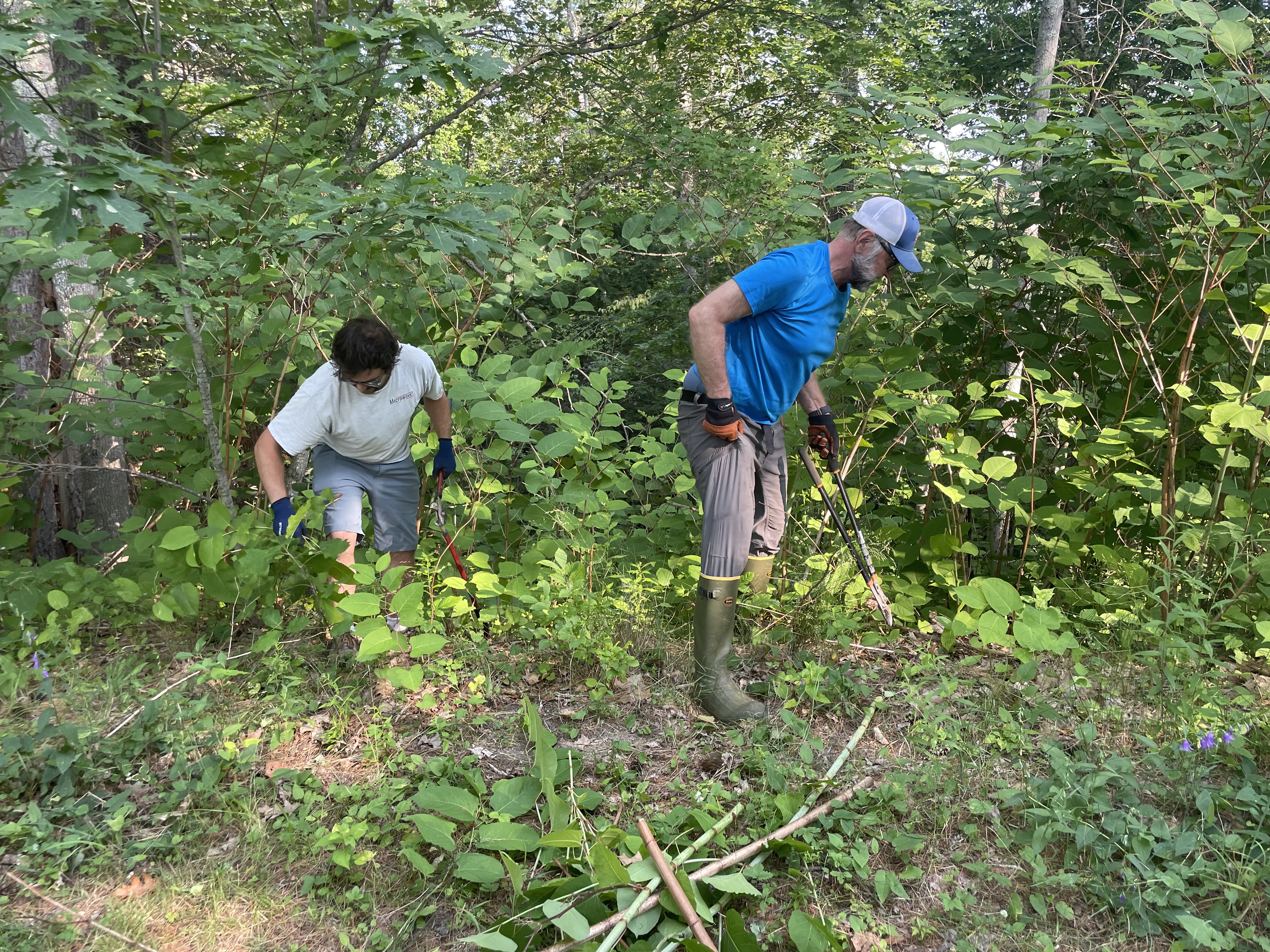
Volunteer Chris Oostenink, of Windham, 60, paused his chopping to yank a twisty vine of the invasive Asiatic bittersweet out of the tangle of knotweed. Multiple invasive species can grow tightly together in the same area.
“It will climb up into the canopies,” Oostenink said. “You can see completely dead trees that look like they’re super bushy and alive, and it turns out that it’s a dead tree, just with so much of this stuff wrapped around it.”
The volunteer sessions, which Edenfield said attract an average of five people, will continue through the end of her service to the land trust in October. The sessions are Wednesdays from 5:30 to 7 p.m. and Sundays from 10 a.m. to 1 p.m. The sign-up for the email list to find out where each session will be held can be found on the Presumpscot Land Trust’s website.
“I think it would be really cool to go back to places that we’ve worked on and see how our impact has affected it and maybe keep going,” Edenfield said.
More information on control methods for Japanese Knotweed, Common Buckthorn, Asiatic bittersweet and other common invasive plant species in Maine can be found at Maine.gov.