
About 300,000 people. Maybe two dozen screens.
That’s the moviegoing situation in Durham, where 17 of those screens carry mainstream fare at AMC Southpoint and three focus on first-run indies at the Carolina Theatre. You can eke out a few more by including the likes of Duke University’s Griffith Film Theater or the former Full Frame Theater now operated by Fullsteam Brewery.
Of the latter, Fullsteam owner Sean Lilly Wilson told the INDY he hopes to open the brewery’s new American Tobacco Campus location by Labor Day and wants to keep the small theater available as a local resource. In January, it hosted the Black Trans Short Film Festival, with a screening by the tipsy Durham Instagram account Two Beer Cinema Club coming up on June 27.
It’s vital cinematic real estate now that the plentiful days of Durham multiplexes like Wynnsong, Willowdaile, and Northgate are long gone, to say nothing of arthouse attrition everywhere.
“It’s like bowling alleys—nobody’s ever going to build a multiplex again,” predicted Jim Haverkamp, a filmmaker, video editor, and Duke film professor. But Haverkamp and Alex Maness, a photographer and theater tech, are preparing to increase the local screen tally by one when they open Skin and Bones Theater downtown in a few months.
The new microcinema’s curator council includes Penelope Bartlett, formerly the Criterion Channel’s director of programming, among other prestigious film jobs.
“I give a lot of workshops about the future of film, and my crystal ball says the future is going
to be regional.”Alece Oxendine,
executive director, Film Durham
Bartlett is also the creative director of Film Durham, a nonprofit founded in 2024 that aims to become the hub of cinematic activity in the Bull City. Dedicated to cultivating local industry and talent, it has also started to program screenings and is long-range-planning a festival.
Though separately conceived, the theater and the nonprofit have strikingly aligned values. Both see cinema less as commercial content than as a vibrant form of civic life.
Both emphasize accessibility, inclusivity, and local identity over top-down curation from larger markets. Both want to hold spaces where all kinds of cinephiles and filmmakers can build a sustainable scene that fits an eclectic city like Durham.
“I give a lot of workshops about the future of film,” said Alece Oxendine, Film Durham’s executive director, “and my crystal ball says the future is going to be regional.”
Alece Oxendine fell in love with classic cinema when she saw 12 Angry Men on TV as a preteen. “I was locked in,” she said. “It’s holding my attention, and it’s only one room. There’s no action. There’s no boom, all these crazy effects. But it was the story. It was the acting. I said, ‘Whatever this is, I want to do this.’”
Soon she was directing the theatrical version at Durham School of the Arts. She went on to take film electives at Jordan High School, a year behind the Duffer brothers, and interned at Durham’s public access TV. “Durham high schools used to have specializations for each public school,” she explained, “and Jordan’s was film and media.”
After graduating college, she built a career in marketing and distribution, working with the likes of the New York Film Festival and Rooftop Films. Now she’s the programs and industry manager at the Gotham Film & Media Institute, splitting her time between New York and Durham.
After Bartlett moved to Durham in 2022, she and Oxendine soon became friends and started talking about how to channel their shared industry experience into something distinctly Durham.
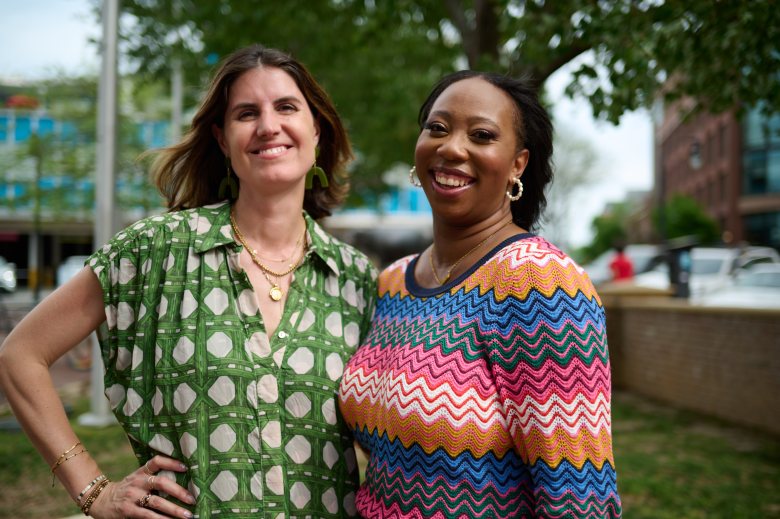
“We wanted to start a film festival initially,” said Oxendine, “but we realized we wanted to build a film community first. We saw firsthand how exclusionary a lot of festivals can be. When we’re bringing films to Durham, we want to make sure it’s accessible for everybody.”
Film Durham has put on three events so far. It started with a program of playful holiday shorts last December, projected on Main Street in collaboration with Downtown Durham Inc. In February came a local Black media panel on Parrish Street—the historic Black Wall Street where Nicole Oxendine, Alece’s sister, long kept her Empower Dance Studio. And in March, Film Durham brought noted film critic A. S. Hamrah to Letters Community Bookshop.
“We want to have year-round programming that is supporting local filmmakers, like a film society, but I don’t want it to sound too buttoned-up,” Oxendine said. “I think what’s going to be important for us is our access to actors and directors. We’ve seen this time and time again—if there’s a Q and A with the director, or it’s a North Carolina premiere, there’s a higher likelihood that people will attend.”
The goal is to build a film scene that doesn’t just reflect Durham but also benefits it. Film buffs remember when Wilmington was “Hollywood East” in the 2000s, thanks to the state’s generous film-industry tax credits. When those went away, so did the industry, much of it to Georgia.
But today the North Carolina Film and Entertainment Grant offers filmmakers significant rebates, and Oxendine sees an opportunity to build something lasting in Durham.
“The challenge is we don’t want to end up like Georgia, [where] Hollywood brings their people with them. They are contributing to the local economy, but for a short period of time,” she said. “If we have our own indie ecosystem, it’s really impactful. If people can not just shoot here but also do post-production here, that adds to the economy in the state.”
Film Durham is eyeing a fall position for an annual festival. They hope to use their connections to bring in festival-circuit fare curated for Durham and include some local programming, too. But not this fall—building trust takes time.
“We want to bring actors and directors to experience the beauty that is Durham with an engaged, diverse audience,” said Oxendine. “That’s why our first priority is to cultivate our relationship with our audience. So when we launch our festival, it’s not like, ‘Who are these people?’ There’s a big push toward regionality in the industry, and there’s a special place for that small theater, like Skin and Bones, where we can show interesting things.”
To comment on this story, email [email protected].