
Theodore McCarrick, the disgraced former Newark archbishop and cardinal who was cast out of the ministry after decades-old sexual abuse allegations involving young men and boys ultimately came to light — sparking a reckoning in the Catholic church and a soul-searching moment for the Vatican — has died.
The former cleric, who had been in poor health, was 94 years old.
Cardinal Robert W. McElroy, archbishop of Washington, where McCarrick had been the spiritual leader after leaving Newark, confirmed the death in a statement but did not provide additional details. A spokeswoman for the Archdiocese of Newark did not immediately return a request for comment.
McCarrick was the highest-ranking American official to be removed from the priesthood. He was laicized, or dismissed from the clerical state — considered one the harshest forms of punishment that can be issued by the church — after the Vatican found him found guilty of soliciting for sex while hearing confession, and sexually abusing minors and adult seminarians over decades.
The scandal surrounding McCarrick came amid sweeping investigations across the country into the dark secrets of the past of abusive members of the clergy. Soon came painful disclosures by a Pennsylvania grand jury of sex abuse by priests who preyed upon children for decades, and a clergy abuse task force that was launched by the New Jersey attorney general.
His downfall came quickly following allegations that became public in 2018 that he had abused a teen 50 years earlier while serving as a priest in New York.
By then a cardinal and the Archbishop Emeritus of Washington, D.C., McCarrick was abruptly removed from public ministry after the Archdiocese of New York announced that a review board had substantiated those claims of abuse.
With his removal, church officials in New Jersey separately revealed that McCarrick had previously been accused of sexual misconduct with three adults during his time in the state.
Two of those cases resulted in secret legal settlements with undisclosed terms, according to the Archdiocese of Newark. Ordered by the pope to withdraw from public ministry and events and contemplate a life of prayer and penance, McCarrick was forced to resigned from the College of Cardinals.
In February 2019, the Congresso of the Congregation for the Doctrine of the Faith issued a decree finding him guilty of solicitation in the Sacrament of Confession, and sins against the Sixth Commandment with minors and with adults, “with the aggravating factor of the abuse of power.” With the decree, McCarrick was defrocked, or removed from the clerical state.
He never admitted to the abuse, but accepted his punishment.
“While I have absolutely no recollection of this reported abuse, and believe in my innocence, I am sorry for the pain the person who brought the charges has gone through, as well as for the scandal such charges cause our people,” McCarrick said in accepting the Vatican’s decision to remove him from ministry.
He later told a reporter for Slate, “I’m not as bad as they paint me,” he said. “I do not believe that I did the things that they accused me of.”
However, McCarrick has been repeatedly accused of sexual abuse in other court filings as well, and was later hit with criminal charges and the possibility of prison.
Criminal charges
In 2021, he was criminally charged in Massachusetts on three counts of indecent assault and battery involving a 16-year-old boy involving an incident dating back decades. The alleged victim, whose name was redacted from the court papers, said he was assaulted by McCarrick at age 16 at his brother’s wedding at Wellesley College in 1974.
Despite the amount of time that had passed, authorities were able to bring criminal charges because McCarrick was not a Massachusetts resident at the time of the alleged assault and the statute of limitations stopped running when he left the state.
His lawyers sought to dismiss the case in February 2023, telling a judge that he suffered from dementia and was not competent to stand trial. A day later, McCarrick spoke to a reporter for NorthJersey.com and said the alleged victim’s testimony was “not true.”
In August of that year, a judge in Massachusetts ultimately ruled he was not competent to stand trial, after a forensic psychologist employed by the state testified that she had found significant cognitive problems and “deficits of his memory and ability to retain information” after she assessed McCarrick at his residence over the course of two days.
Former Cardinal Theodore McCarrick arrives at Dedham District Court in September 2021 to plead not guilty to sexually assaulting a 16-year-old boy during a wedding reception in Massachusetts nearly 50 years ago.AP
In April of 2023, Wisconsin authorities charged him with sexually assaulting an 18-year-old man more than 45 years ago. In a criminal complaint, the state charged the McCarrick fondled a man in 1977 while staying at a cabin on Geneva Lake in southeastern Wisconsin.
The alleged victim, who was not named by the state, told investigators that McCarrick had repeatedly sexually assaulted him since he was 11 and even brought him to parties where other adult men sexually assaulted him, according to the complaint. However, that matter was suspended in January 2024 after he was deemed incompetent because of dementia. A judge in Wisconsin in December 2024 ordered that the case remain paused until the laicized clergyman died.
Prosecutors had asked the trial remain “in suspended status, telling the court they were “not ready to dismiss this matter.” McCarrick’s attorney called for its dismissal, citing McCarrick’s “extreme deterioration.”
A flood of civil litigation in New Jersey followed a lifting of the state’s statute of limitations for non-criminal allegations, under a new law that gives people more time to sue their alleged abusers and the institutions that protected them.
James Grein, one of the former cardinal’s accusers, claimed McCarrick had repeatedly exposed himself to Grein when he was 11 and then sexually molested him for years thereafter. He said that McCarrick — a close family friend — would take him upstairs to hear his confession before celebrating Mass for the family at home.
Lawyers for an unnamed victim charged that the individual they named only as “Doe 14” had been groomed for a role in what they called a “sex ring” involving McCarrick at a Jersey Shore beach house. In that lawsuit, they charged other priests served as “procurers” to bring victims to McCarrick at the beach house, where he “assigned sleeping arrangements, choosing his victims from the boys, seminarians and clerics present at the beach house,” and that they were paired with adult clerics.
John Bellocchio, a former Catholic schoolteacher and principal, has alleged in a lawsuit that McCarrick sexually assaulted him when he was the archbishop of Newark. And Geoffrey Downs in another lawsuit against the McCarrick, charged that he had been groped by the cleric before Mass while serving as a teenage altar boy decades ago.
And another unnamed “John Doe” who had attended religious schools in the Newark Archdiocese charged in a lawsuit he had been sexually molested by McCarrick beginning when he was 14, from 1982 to 1983.
And in a report by an independent investigation commissioned by Seton Hall University, investigators concluded that McCarrick “created a culture of fear and intimidation” and sexually harassed men studying to be priests at the seminary at the Catholic university.
POWER AND INFLUENCE
Once the most recognized Catholic leader in New Jersey, McCarrick was a leading voice on national issues for the church, traveling the world for the Vatican. And despite the allegations that went high into the Vatican for years before they were later made public — according to the Vatican’s own reports — McCarrick’s star continued to rise and he wielded immense influence within the Catholic Church.
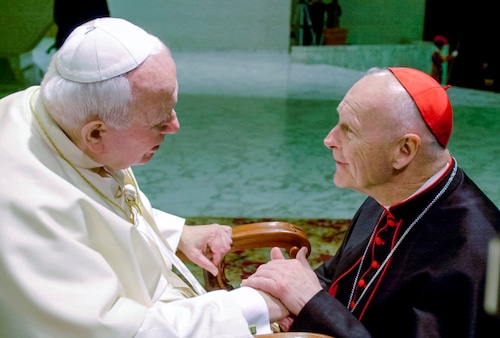
McCarrick, then archbishop of Washington, D.C., shakes hands with Pope John Paul II during a general audience with newly appointed cardinals in this 2001 file photo.AP
Born in New York in 1930, McCarrick grew up in Washington Heights and began his road to the priesthood as an altar boy at his neighborhood parish, the Church of the Incarnation. After high school, he studied in Europe and went to Fordham University, and then enrolled at St. Joseph’s Seminary in the Dunwoodie section of Yonkers, N.Y.
Ordained a priest in 1958 by New York’s Cardinal Francis Spellman, McCarrick was sent to Puerto Rico and in 1965 became president of Catholic University in Ponce.
In 1981, he was named the first bishop of the new Diocese of Metuchen. Five years later, he was named archbishop of Newark. His rising prominence was put in the spotlight n 1995, when Pope John Paul II came to visit the Cathedral Basilica of the Sacred Heart — the seat of the Archdiocese of Newark Archdiocese.
While still in Newark, McCarrick was said to be looking at retirement when he turned 70. But Pope John Paul II picked him as Washington’s archbishop in late 2000. And in 2001, the pope made him a cardinal.
His fall came quickly, and as the allegations against him grew, Catholic Church officials promised a thorough investigation of what Rome knew and when they knew it. In late 2020, the Vatican released an unprecedented 449-page report charging that that for decades, bishops, cardinals and even popes downplayed or dismissed reports of sexual misconduct.
It largely blamed Pope John Paul II for ignoring those reports, believing McCarrick’s last-minute, handwritten denial that he did anything improper.
In one of the more bizarre aspects of the story, Vatican investigators also revealed that McCarrick was targeted by the former Soviet Union as a possible intelligence asset, amid his rising celebrity within the Catholic Church.
In the early 1980s, a KGB agent who enjoyed diplomatic cover as the Deputy Chief of Mission to the United Nations for the Soviet Union approached McCarrick, apparently to attempt to befriend him, according to the Vatican report. McCarrick, who was initially unaware that the diplomat was also a KGB agent, was contacted by the FBI, who asked him to serve as a counterintelligence asset.
McCarrick believed it was best to decline such involvement, despite the FBI’s encouragement to allow a relationship with the KGB agent to develop.
Local journalism needs your support. Subscribe at nj.com/supporter.
Ted Sherman may be reached at [email protected]. Follow him on Twitter @TedShermanSL