
Local News
David Sabatini, once a prominent scientist at MIT, sued a former colleague who accused him of inappropriate behavior. A jury found in his favor.
A prominent Massachusetts Institute of Technology biology professor forced out of his job over sexual harassment allegations won a defamation case against his accuser Friday, along with a $6 million award.
The biologist, David Sabatini, was among the most prominent scientists in his field and ran a research lab at the Whitehead Institute in Cambridge for 24 years. His lab studied cellular biology to better understand neurodegenerative diseases, cancer, diabetes and aging.
He was forced out of his lab in 2021 after an internal Whitehead investigation concluded he had a past sexual relationship with a younger and less experienced colleague, Kristin Knouse, over whom he had a career-influencing role. The investigation also found that his lab had maintained a sexualized atmosphere. Knouse said that the relationship was coerced.
But Sabatini denied his lab had an improper atmosphere. He maintained that his relationship with Knouse had been consensual and that Knouse had schemed to get him fired and disgraced after he became interested in another woman.
“It’s surreal,” Sabatini, 58, said in a phone interview after the verdict. “I’ve been dreaming about this moment for all this time, but often thinking I might not make it, financially, emotionally or physically.”
Nearly five years to the day after he filed his defamation lawsuit, a Suffolk County jury agreed with him, finding that Sabatini had proved in court that Knouse had defamed him and interfered with his ability to work.
The jury rejected Knouse’s counterclaims that Sabatini had harassed and retaliated against her.
Knouse’s lawyer, Ellen Zucker, said in an interview Friday evening that Knouse would appeal the decision.
“The sad reality of our time is that society still has a difficult time believing women and appreciating the difficulty they encounter with men who too often control their fate,” Zucker said. She said Knouse “came into court and told the truth.”
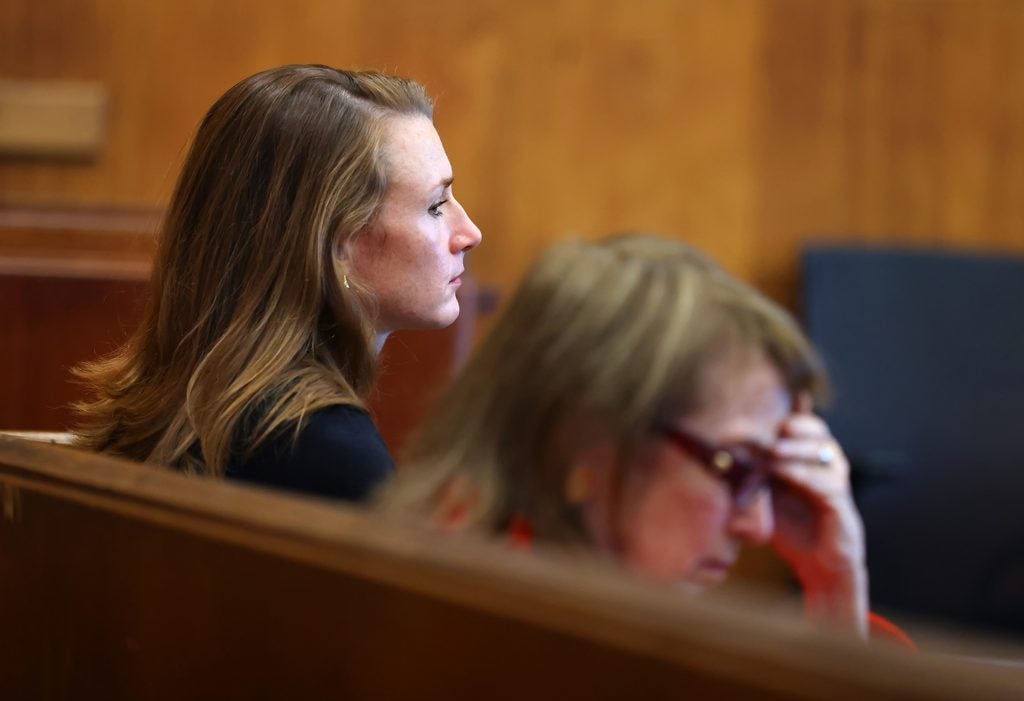
Knouse is an assistant professor of biology at MIT and on the faculty of the Koch Institute for Integrative Cancer Research, which is affiliated with MIT.
Sabatini’s career was derailed by the allegations. After he was pushed out of MIT and the Whitehead, he had talks with New York University about a job. But NYU staff members and students protested in the streets against his hiring in 2022, and the university did not hire him.
In 2023, he was hired by the Institute of Organic Chemistry and Biochemistry in Prague and later opened a Boston-area branch of that institute. He has been splitting time between Massachusetts and the Czech Republic.
Sabatini said he hopes the verdict is a step toward regaining his reputation. “Before, I was judged as having a great lab and for providing great mentoring,” he said. “For the most part my trainees have been there for me through this.”
“I hope that I can get back to being judged by my science and my training,” he said.
The Whitehead Institute, in a statement after the verdict, said that earlier legal claims against the institution had already been dismissed, adding, “Therefore, Whitehead was not a party to this case, and the decision and judgment only apply to Drs. Sabatini and Knouse, the parties in the case.”
A spokesperson for MIT did not immediately respond to a request for comment.
This article originally appeared in The New York Times.