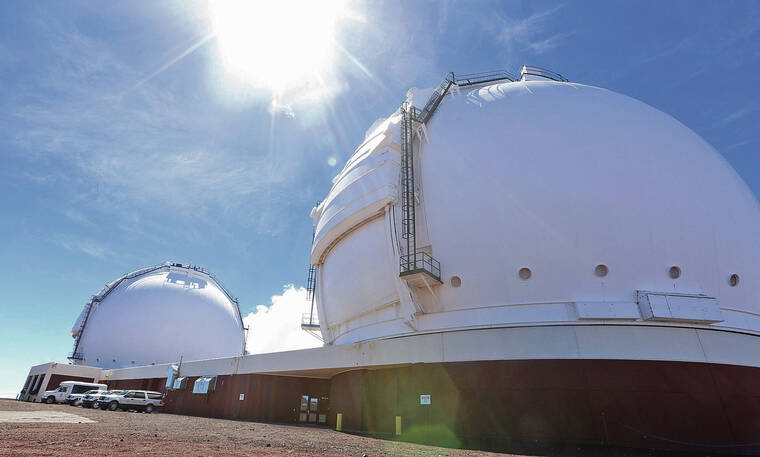
Astronomers using the W.M. Keck Observatory on Mauna Kea have confirmed two-thirds (21 of 31) of the most ancient quasars from the European Space Agency’s Euclid mission, including two of the most distant ever observed.
Quasars represent a brief phase in a galaxy’s life during which large amounts of material spirals into the central supermassive black hole, releasing enormous amounts of energy. In this phase, the galaxy’s nucleus can become one of the brightest persistent sources in the universe.
Astronomers have been hunting for the universe’s earliest quasars for decades. These celestial archives reveal conditions in the earliest days of the cosmos, including how the first supermassive black holes and galaxies took shape. But accessing them isn’t easy. Quasars from this era are difficult to find: They are elusive, as few galaxies had time to grow large enough, and their light has traveled for more than 13 billion years to reach us, arriving faint and stretched into infrared wavelengths, where it can resemble nearby cool stars.
“We see these quasars as they were during the universe’s infancy,” says Daming Yang, lead author of the study and graduate student at Leiden University in the Netherlands. “By finding and studying them, we can better understand how these enormous systems formed and grew so quickly — one of the greatest mysteries in astrophysics.”
More information can be found at keckobservatory.org/ancient-quasars.
Evening observing
At sunset, Manaiakalani will be at its zenith and Ka‘iwikuamo‘o will begin to creep closer to our western horizon through August, showing that we are now beginning to enter fall. After sunset, as we look toward the direction of hikina (east), we are able to see the western half of Kalupeakawelo rising with the two chief stars Kakuhihewa (Scheat) rising in ‘Aina Ko‘olau and Keawe (Markab) rising in La Ko‘olau.
Morning observing
At 6 a.m. Kekaomakali‘i will be up in the night sky before the sun rises in the house of La in the Ko‘olau (northeast) quadrant, and in the west half of the night sky we can still see Kalupeakawelo.
The ‘Imiloa Astronomy Center of Hawaii is a center for informal science education at the University of Hawaii at Hilo showcasing astronomy and Hawaiian culture as parallel journeys of human exploration.