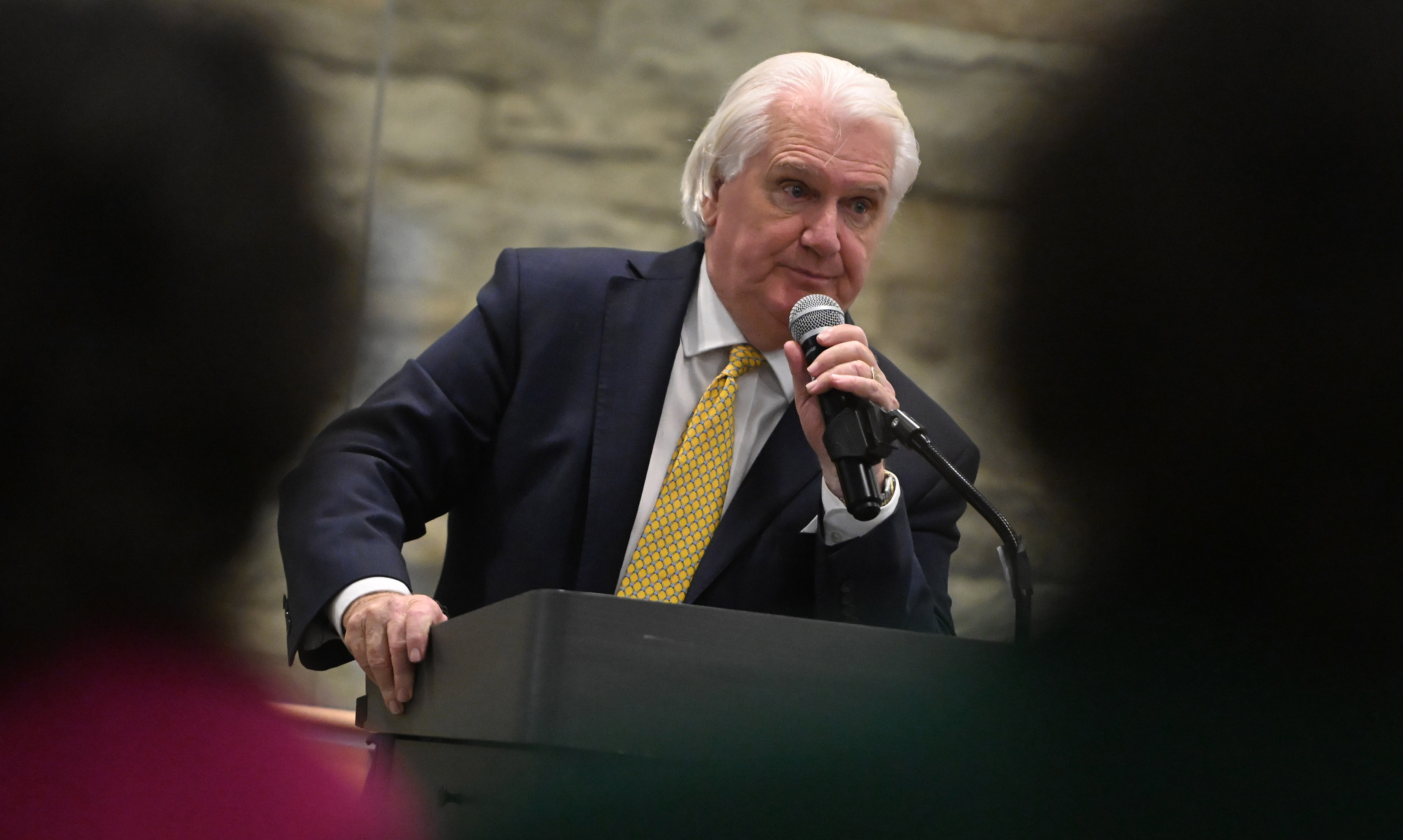
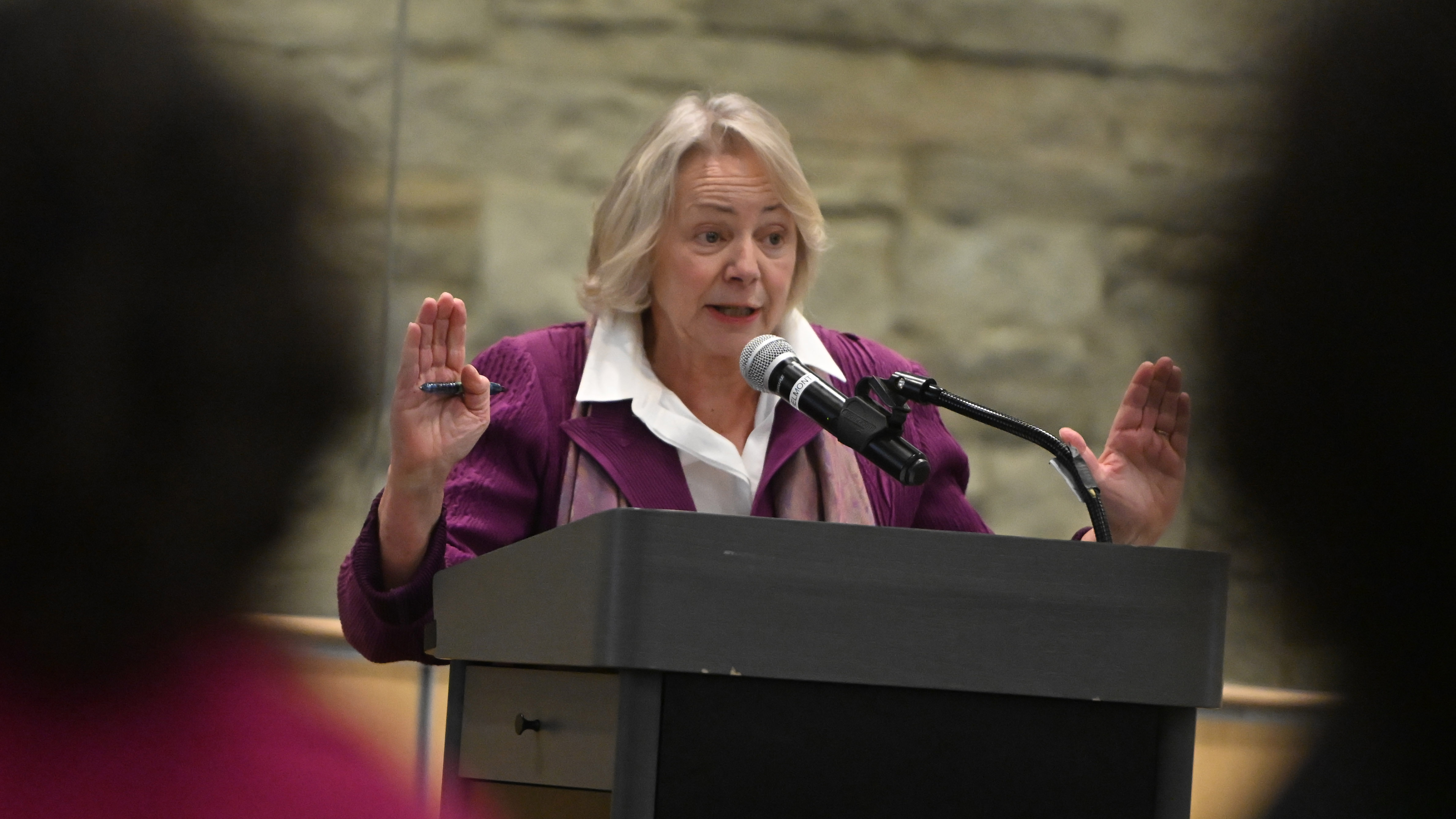
At a county executive face-off on Saturday, Howard County Executive candidate Liz Walsh was the solitary voice to criticize remarks by candidate Bob Cockey that she characterized as “racist.”
Cockey, a longtime restaurateur, is the most recent Howard resident to join the 2026 race for the county’s top position. When asked about what he would do to represent the over 60,000 Asian American and Pacific Islander residents in the county, Cockey’s answer, which praised the community, provoked the current District 1 councilmember’s displeasure and some groans among the crowd.
“You guys aren’t taking up any space in our prisons; you guys are raising the bar in schools,” Cockey said of the Asian American and Pacific Islander community. “You guys are bringing into the community — you’re not taking out of the community. I thank you for it.”
Walsh’s response garnered her a round of applause from the dozens of residents sitting in the audience.
“I represent every part of this community — whether Asian or otherwise, and when people say crazy racist stuff, you have to stand up and say, ‘That is crazy racist stuff,’” Walsh said. “I think that you will not find a candidate who is stronger in standing up for every part of our diverse community.”
The lively exchange was part of a forum at the Elkridge Library hosted by Illuminate Maryland, a youth-led advocacy organization tasked with increasing civic engagement in young people statewide. This was the first forum put on by the Howard County high schoolers.
In the battle of the Democrats, environmental and education issues were priorities for all four candidates. So far, no Republicans have filed for the race. The filing deadline is Feb. 24.
Environment
Del. Vanessa Atterbeary plans to utilize her connections made throughout her near 11 year tenure at the Maryland General Assembly to address the growing environmental concerns in the county. She believes the way to address climate concerns in the county is to create “partnerships.”
Howard has so far reached 26% of its 2030 goal of a 60% reduction in climate warming emissions. Atterbeary said the way to close that gap amid federal setbacks is by leveraging relationships and not be “divisive.”
“I think that the [county] climate forward plan is a great start, but we need to be more ambitious, and so I would put together a group of folks from all over to work on this issue,” Atterbeary said. “Howard County deserves a leader that is not divisive, that is going to work with other people to actually get things done.”
Walsh said the climate situation was in “chaos.” She believes there are plenty of solutions the county is not using, such as making county buildings more energy efficient and making more use of renewable energy.
“It has to be done immediately,” Walsh said. “There cannot be incrementalism and this county of all places has the resources.”
Councilmember Deb Jung believes there should be solar panels everywhere. She is in favor of giving out incentives to encourage developers and residents to implement “greener” strategies. She remarked that at the county level, she was in favor of updating building codes to incentivize more environmentally friendly construction additives.
“Whether it’s putting in more electric chargers, whether it’s getting those warehouse orders to put in solar panels, whether it’s finding incentives for people to use less electricity, or to use electricity instead of fossil fuels, whether it’s trying to incentivize new people who are building new buildings to use that electrical hookup — that they now have to use under our building codes — there has to be a way to get people to do more of this more quickly … [to] make sure that we get a lot closer than 26%,” Jung said.
Cockey does not believe solar energy is the answer. He proposed turning to hydropower, carbon-neutral biofuels and geothermal energy sources as alternatives.
“It’s not efficient, it’s ugly,” he said. “I am 100% against solar.”
Education
Cockey denounced the county council’s recent approval of the Columbia Lakefront Library — specifically its $144 million price tag. He believes the money should be redirected to the schools to address their long-needed repairs.
“We don’t need any more money; we need to work with the budget we have,” Cockey said.
Walsh revered universal pre-K and its potential in bridging the achievement gap but expressed the struggles for the county to find the space to hold pre-kindergarten students. She would want to expand the county program since pre-K serves as the first line of defense for students, where they can first be flagged for learning disabilities and can address English as a second language before getting to “remedial subjects” in kindergarten and first grade.
“It makes a huge impact [and] the incremental costs are low,” Walsh said.
Atterbeary echoed her sentiment backing the need and benefits of pre-K, celebrating her role in its implementation at the state level.
“It was my legislation at the state level that actually created universal pre-K for all students in the state, and I’m incredibly proud of that,” Atterbeary said. “Because I have that experience from the state level, I can bring that to the county.”
She also advocated for continuing the Black Student Achievement Program, which supports access to diverse learning opportunities and social emotional development for Black students through the school system.
Jung hopes to address the achievement gap in schools by making sure budgets do not continue to decrease. She pointed out that in 2024, 199 positions were cut from the school district. Last year, 127 positions were slashed.
“We can’t continue to concentrate poverty in the schools without providing more resources to those folks,” Jung said.
Have a news tip? Contact April Santana at [email protected] or at 443-834-7525.