
In a packed auditorium at North Carolina Central University on Tuesday, the Campus Echo hosted this Durham municipal election’s only mayoral debate. While Anjanée Bell and Leo Williams have met in forums through the primary it was the only opportunity they had to appeal to voters in a head to head format before Election Day on November 4.
The candidates agreed on issues including fare-free buses and increased support for the arts, and had their biggest disagreements over a controversial development proposal in the historic Hayti community, approaches to crime, and whether or not Williams is overly dismissive of residents’ concerns about overtaxation. They also dug into homelessness, the city budget, downtown parking, student housing, and more.
Here are our biggest takeaways from the debate.
Bell had a tougher assignment
As it is for all challengers, the onus has been on Bell this election season to prove to voters that she is worth bucking the incumbent. Williams, who is seeking a second term as mayor, coasted through the primary with about 55 percent of votes to Bell’s 30 percent. Since then, she’s surely been hoping to flip some Williams primary voters, pick up some votes from the less successful primary candidates (Pablo Friedmann pulled a solid 12 percent) and win over some new voters who sat out the primary.
Bell has sought to consolidate anti-Williams sentiment among some of the city’s politicos and councilwatchers by going after the mayor for his development-friendly attitude. Since she’s the challenger, she’s able to criticize Williams’s work on the city council (“There are issues on council with your leadership,” she said) but it also means she can’t tout a governance record of her own.
After the debate, she told INDY that her main message to voters was commitment.
“Commitment is important in leadership in this city,” she said. “Being accountable, listening to answer the questions, not going off somewhere else to deflect, I think staying committed, no matter how uncomfortable it might have been, that was important for me, and I hope that authenticity is what the audience got from me tonight.”
She said she hoped that anyone hearing her speak for the first time went home feeling “fired up about getting involved.”
Similarly, Williams said that he hoped debate-goers heard something that would inspire them to go vote.
“I hope that they will do their homework and look at who they should vote for, and I hope that they will have vision for the city and vote for the candidates that have vision, such as myself [and] Mark-Anthony Middleton,” he told INDY after.
Development was front and center
The clearest division between the candidates was on the Heritage Square rezoning case.
Bell has previously criticized Williams for his handling of the rezoning request, which would have included a 10-story office building, two eight-story life science facilities, 27,000 square feet of retail space, and roughly 400 residential units.
The developer hosted over 50 “stakeholder” meetings with residents and community groups, steadily compiling a list of potential community proffers. Still, opponents who packed the city council chamber over the summer said the proffers didn’t go far enough to ensure the development would benefit, rather than harm, the surrounding community.
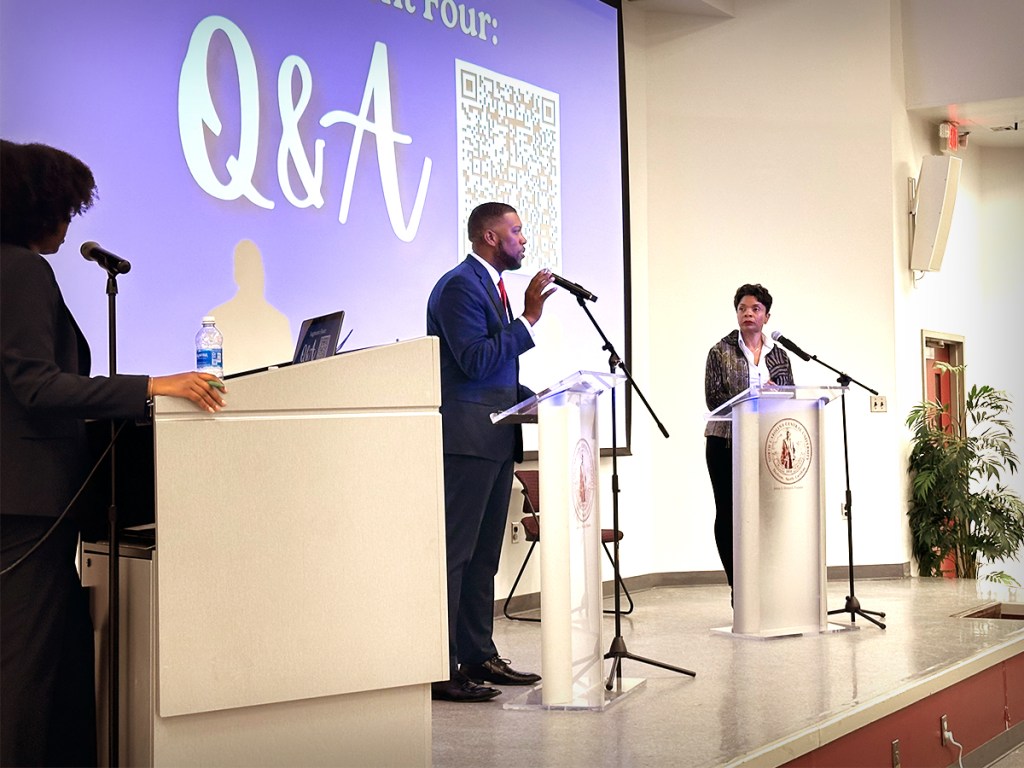
“It’s always people over profit for me, and the voices of Hayti, they spoke. They spoke clearly,” Bell said at the debate as she criticized Williams for not moving forward with a public hearing on the rezoning after the developer pulled the request in a surprise move. “This leadership could not stand with courage to allow the people to speak.”
Williams, in his response, listed some of the benefits that the city negotiated with the developers, including scholarships for NCCU students and space designated for women-owned businesses.
“It would have expanded so many jobs and so much revenue for the city. It was three years of community engagement.” Williams said. “What hurts me is, what do we have now? Nothing.”
It’s the economy, stupid
Like development, taxes and the cost of living are always at the center of local elections.
Williams was on-message with his plug of an “innovation center,” the signature capital improvement project, which he says will revitalize a downtown that has been slow to regain the foot traffic it lost during COVID.
“We’re now the third largest city in North Carolina, but we have the smallest convention center,” he told the crowd. “We lost $72 million in denied contracts because of capacity.” His pitch is to create a space that can also be used by students and local companies to avoid any slump in revenue when conventions aren’t in town. He said that adding those spaces could raise sales tax revenue, helping to keep the burden off residential taxpayers.
Bell said that she wasn’t on board with the convention center because there are better uses for that investment. She pointed out the downtown parking costs as a good starting point, arguing that those costs are discouraging people from visiting downtown and spending money.
“It is impacting business,” Bell said. “It is impacting our ability to generate additional revenue.”
She also said that some people have concerns about safety, and that more lighting could help.
The candidates also addressed the cost of housing for students specifically. NCCU’s enrollment grew by 13.5 percent in the past year, making it the fastest growing school of the 17 UNC system campuses. That brought the school up to about 8,000 enrolled students and has left the campus, per chancellor Karrie Dixon’s earlier comments, “busting at the seams.”
Bell said that she would partner with nonprofits and local developers to repurpose vacant commercial spaces through the city, while Williams said that he would focus on building relationships between developers and the university.
The real winner was NCCU and its students
Both candidates were determinedly on message. Both fell short of any stellar breakout moments and both avoided any obvious gaffes, though they did have one especially tense exchange when Bell accused Williams of dismissing residents’ concerns about affordability without apology. (Bell: “You made a comment [to an elderly woman] about not knowing how to do math.” Williams: “I do not remember telling someone they don’t know how to do math.”)
NCCU’s students, though, made an impressive showing both in hosting this cycle’s only debate and in filling an auditorium on a Tuesday night to hear about local politics.
The moderator, the Campus Echo’s Ronni Butts, respectfully kept the candidates on topic and the conversation moving with a thoughtful series of questions. The organizers swiftly and professionally removed a heckler who repeatedly interrupted the first few minutes of the debate.
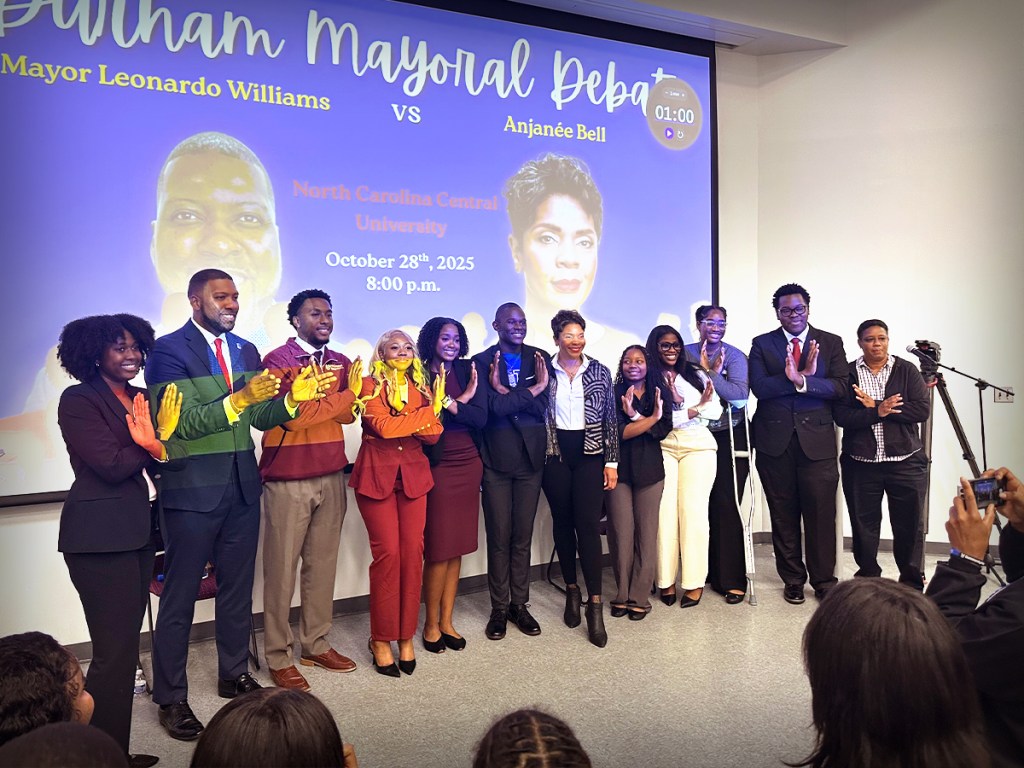
Credit: Photo by Chase Pellegrini de Paur
Hosting a debate also helps boost the school in the municipal conversation. The candidates, both NCCU alum, paid a reasonable amount of lip service to their Eagle accreditations.
“I see you. I was you,” said Bell in her opening remarks. “You are the thinkers, the innovators, the truth tellers, the bridge builders, who may help decide what Durham becomes next.” She also discussed plans to help students get work experience within Durham.
Williams, later in the debate, mentioned a proposal for a designated university to downtown bus line, and suggested that the city could help sponsor a homecoming concert in the future.
Reach Reporter Chase Pellegrini de Paur at [email protected]. Comment on this story at [email protected].