When a health issue led Cherryfield native, Lou Torrey, to withdraw from college following her freshman year, she had every intention of returning. But full-time jobs followed by parenthood and homeschooling, made it more difficult than she anticipated. Before she knew it, 20 years had passed.
“I got stuck in the rut of the real world, and lost touch with the academic one,” Torrey says. “Life just went by.”
As her two kids have gotten older, Torrey has had more time to focus on personal goals, including rejoining the workforce. However, she didn’t want to return to the service jobs she’d had in the past. To unlock higher-paying career opportunities, Torrey dreamed once again of a college degree. But the prospect of juggling classes with homeschooling, childcare, and other responsibilities seemed impossible.
That’s when Torrey saw a friend post online about Family Futures Downeast, a program in Washington County to help parents pursue post-secondary degrees and credentials while benefiting their whole families. With this kind of backing, Torrey felt like she could finally give college another try.
Breaking barriers, supporting success
Informed by the perspectives of families in Washington County, Family Futures Downeast is a two-generation program that supports parents and their children simultaneously. Serving a region with some of the state’s highest poverty rates, the program has helped families build lasting economic opportunity and well-being across generations.
“We’re not just reducing the risk that kids will grow up in poverty,” says Executive Director Marsha Sloan. “We’re helping parents imagine a career pathway and a future for their families.”
Through the program, parents take college prep classes through Washington County Community College or University of Maine-Machias with a cohort of fellow parenting students. At the end of two years, participants earn a certificate in Family Studies or Liberal Studies, as well as college credits toward an associate’s or bachelor’s degree.
The program breaks down barriers to support their success. It provides access to technology, books, transportation, and childcare, intensive one-on-one coaching to problem solve along the way and a curriculum designed to prepare them for academic success. It also assists with urgent needs that threaten to derail parents’ academic journeys like housing, food security and essential vehicle repairs.
“Once the parents are enrolled in college, it’s about making sure they can focus on their work,” Sloan says. “We sit down with them and say, ‘What’s the most important thing?’ and come up with a strategy to achieve it.”
For many parents, that “most important thing” is knowing their children are supported, as well. Coaches help families assess their young children’s development, identify any supportive services they might need and connect to early childhood education. Older children work with a youth coach who can help them identify their goals and access opportunities for learning and growth.
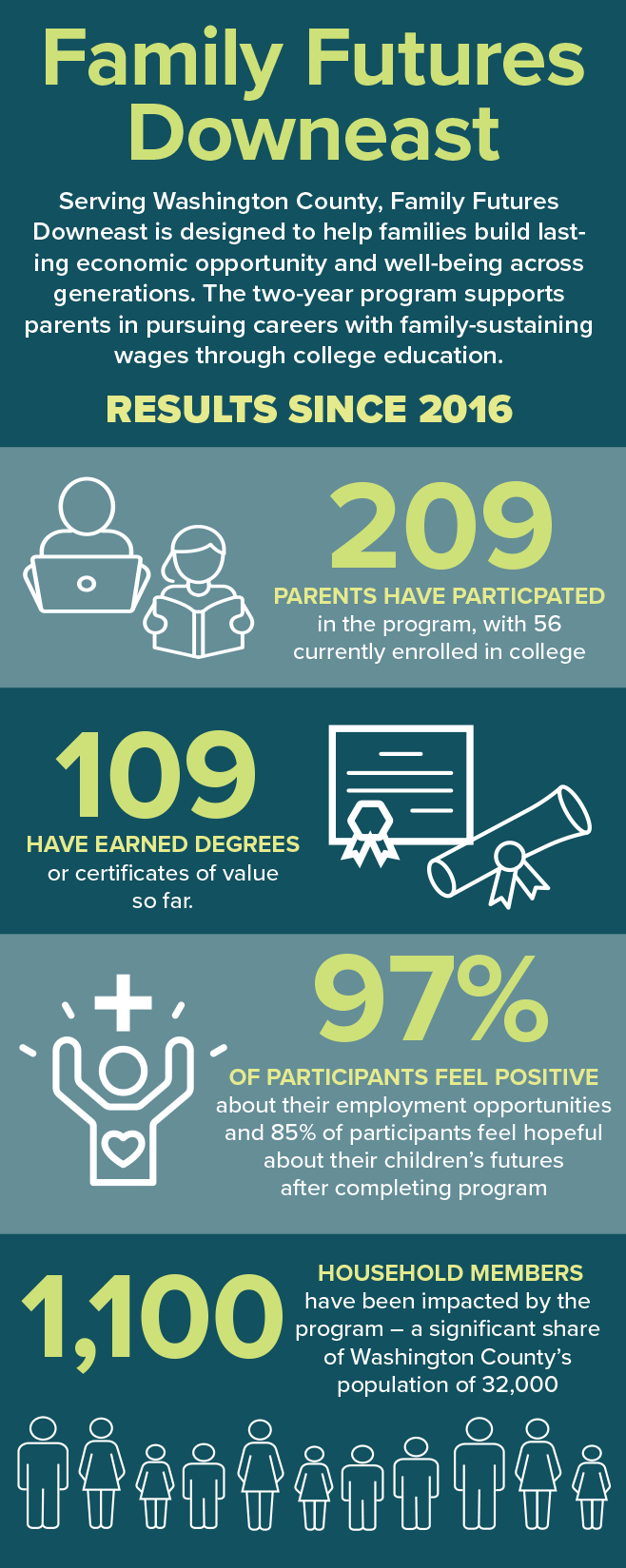
Now in its 10th year, this two-generation program is nationally recognized for the success it has had in helping parenting students advance their education. Since 2016, 209 parents have participated in Family Futures Downeast. While 56 are currently enrolled in college, more than half of total participants (109) have successfully earned degrees or certificates of value so far. These parents have pursued careers as realtors, recovery coaches, educators and a wide variety of other positions in the community.
Sloan says one of the program’s most powerful outcomes is the change in outlook that parents report after taking part in the program. In surveys, 97% of participants said that they feel positive about their employment opportunities and 85% said that they feel hopeful about their children’s futures.
Support from the John T. Gorman Foundation is now allowing the program to explore ways to deepen this impact in Washington County – including tailoring programming to address the needs of fathers – while sharing its two-generation expertise with organizations across the state.
‘It’s Never Too Late’
Now in her second year, Torrey says the program has been a gamechanger for her family. After signing up, Family Futures Downeast quickly provided her with a laptop and a wi-fi hotspot so that she could attend online classes. She was reimbursed for childcare while she was in class and for gas when she drove to campus. Taking classes with a cohort connected her to other parents with similar experiences. The professors and coaches have made her feel excited and confident about advancing her education.
Importantly, the program has helped Torrey’s children access enrichment and educational opportunities that they might not have been able to afford otherwise. Knowing that their needs are being met has made her feel more comfortable investing her time and energy in school.
This fall, Torrey is taking four classes at the University of Maine-Machias and has her sights set on a creative arts degree and eventually a teaching career. She’s confident that she will walk across the stage to receive her degree and hopes her kids will be inspired to do the same.
“I want to set a good example,” she says, “and show them that it’s never too late to do what you want to do.”
Submit an interest form to speak to a member of the Family Futures Downeast team for more information and to discuss the program.