
In Southern Roots, Spring Council offers a brûléed riff on her late mother’s corn casserole and writes personal essays in a similar register: comforting, with a singed edge.
The cookbook-slash-memoir, out from W.W. Norton and Company this month, intersperses homey recipes with stories of Council’s upbringing in 1960s Chapel Hill as the youngest daughter of the legendary Mildred Council, AKA Mama Dip, whose namesake restaurant stood on Rosemary Street for half a century before closing last July.
As a food writer, Spring Council has chops: she grew up watching her mother cook not with recipes but by smell and sight and feel, and that sensory attention carries into her writing. Cornmeal-coated porgies hit a cast-iron skillet with a “snap, crackle, and pop.” Rock candy gets a “good chew to release the sugariness that had soaked into the string.”
Where the book really finds its footing, though, is in the stories around the food. Page to page, Council’s memoir passages sit somewhere between idyllic and unflinching, with a melancholic yearn—sometimes overt, sometimes aching in the subtext—for places that no longer exist.
Namely: Mama Dip’s, where Council had worked, in various roles, ever since the restaurant first opened in 1976. Council’s tales from the dining room realistically span the spectrum of service industry life: Just as soon as a tearful customer tells Council that the restaurant’s food reminds her of her deceased mother’s cooking, another customer—the reason Southern Roots has two chicken and dumplings recipes—screams because her bowl contained flat, rolled dumplings rather than the pillowy dropped kind her grandmother used to make.
“Steam puffed out of her nostrils and fire came out of her eyes like an angry cartoon character,” Council writes of the aggrieved customer. “A rolled dumpling triggered outrage.”
The book also mourns Chapel Hill’s Northside neighborhood, the historically Black community where Council grew up, steps from downtown Chapel Hill. Council recalls being able to walk to local shops like Danziger’s, a candy store where she tried her first chocolate turtle (“shiny, smooth, and layered with rich, sweet, buttery caramel and crunchy pecan halves”) and Colonial Drugstore, where, after desegregation, she could sit at the counter and order an orangeade. In our modern world of Coke Freestyle machines, the orangeade Council describes sounds absurdly fresh: the drugstore owner would slice an orange in half, crank it against a hand juicer, and shake the fresh juice with syrup over crushed ice.
Beyond lost places, Southern Roots has a way of capturing lost ways of eating. Council grew up with an intimacy to her food sources that has largely vanished, at least for the kind of lower and middle-class families who populated Northside.
The Council family didn’t live on a farm, but that hardly mattered: neighbors grew gardens, local farmers drove up to the restaurant door with seasonal produce, and kids foraged as a matter of course. Council writes about roaming from the neighborhood playground into the surrounding woods and neighbors’ yards with scores of other children, picking pecans, plums, persimmons, muscadine grapes, figs, and wild honeysuckle.
Northside still exists today, but it’s a different place. As Council writes in the book’s afterword, most of the families she grew up with have moved on, and the homes have become student rentals owned by landlords who live elsewhere. In an interview at her current home, a condo across town from Northside, Council said that what makes her proudest about Southern Roots is that it pins down memories that might have otherwise disappeared alongside the places they belonged to.
“The 100 kids that I would have played with on that playground will read my stories and see that what they experienced has been told on a larger scale,” she said.
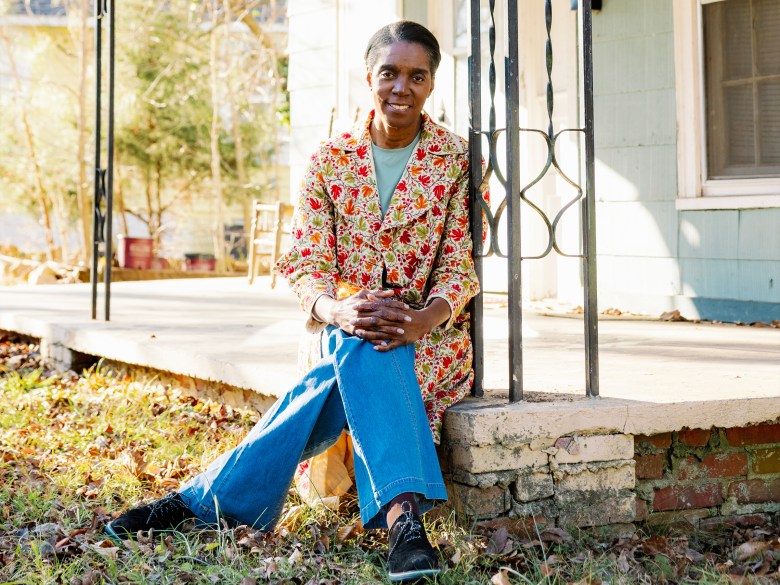
Council has worked in the food world her entire life. She started as a tween assembling takeout boxes at her grandfather’s Bill’s Bar-B-Q, a small Northside takeout spot, then moved on to Mama Dip’s—waiting tables, baking pies, short-order cooking, and eventually taking on a more outward-facing role at the restaurant, representing Mama Dip’s at cooking demonstrations and food festivals.
Last summer, the Council family closed Mama Dip’s for good after a yearlong stint of takeout-only service. Council said the decision to close was straightforward: Her mother had passed away in 2018, and Council and her siblings were all ready to retire. The restaurant’s legacy continues in other forms; Council’s daughter, Tonya, recently opened a café that carries forward some of Mama Dip’s dishes alongside Tonya’s own inventions.
Some of the recipes in Southern Roots are family heirlooms. Others come from what Council calls “having a date with a dish”: tasting something at a restaurant, identifying its flavors, and recreating it at home. The book’s chilled cucumber soup recipe, for instance, hearkens back to a brunch item at the Orient Express, a long-closed restaurant in Carrboro that served food out of vintage train cars.
Council said she wasn’t always able to replicate dishes from memory. For years, she’d bring her attempts to her mother, who’d take a bite and tell her that the texture was off or that the dish was dry. Eventually, Council said, her mom told her she’d never be able to imitate other people’s dishes until she got in touch with the food of her own heritage. She needed to master those recipes first, learn their aromas and tastes and mouthfeels, and build her palate from there.
Council said the method worked. And she’s since applied the same principle beyond the kitchen. All those places she mourns throughout the book—with enough looking inward, she found she could reconstitute them too, at least on the page.
To comment on this story, email [email protected].