
Durham native Eileen Watts Welch was born into a legacy.
Watts Welch has been one of the forces preserving and collecting the history of the Merrick-Moore community as one of the great-granddaughters of John Merrick and Dr. Aaron M. Moore, the neighborhood’s namesakes (in 1916, Moore’s oldest daughter and Merrick’s oldest son married each other).
“I don’t want those stories to be lost,” Watts Welch says.
The neighborhood lies in northeast Durham, anchored around Hoover, Cheek, and Junction Roads.
Last month, Merrick-Moore was designated as Durham’s inaugural Heritage Community, a program created by the city’s Planning and Development Department to honor communities that have never been formally recognized by the city or county. The goal is to celebrate communities and help them gather research so they can apply for future local or National Register designations if eligible.
Merrick, who was born into slavery, met Moore while he was laying bricks at Shaw University, where Moore was a medical student, Watts Welch says. Merrick invited Moore to Durham to provide health care to Black residents, many of whom had left tenant farming and were moving to the city in search of jobs, she says. Merrick and Moore cofounded North Carolina Mutual Life Insurance Company, the cornerstone of Durham’s Black Wall Street and the country’s largest African American life insurance company.
Moore founded Lincoln Hospital in 1901, which his son-in-law, Watts Welch’s father, later developed into the Lincoln Community Health Center in 1970. At the time, it was the only hospital within a 25-mile radius of Durham to treat Black patients.
Although Merrick and Moore weren’t involved in creating the neighborhood, which happened two decades after their deaths, the neighborhood school was named in their honor.
“All Blacks who lived in the county, Durham County, went to high school at Merrick-Moore, and the county named that Merrick-Moore, knowing of all the contributions that both Merrick and Moore had made to education, health care, opportunities for business and family … during their lives,” Watts Welch says.
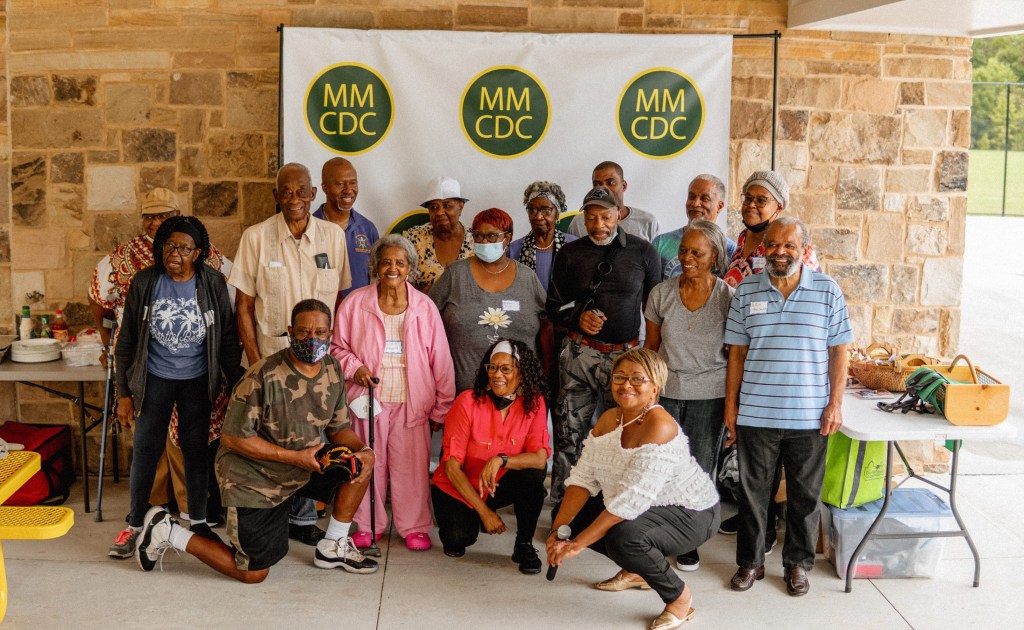
Watts Welch, who is president of the Durham Colored Library (which Moore founded), has worked in her role to preserve the community’s history. The Merrick-Moore Community Development Corporation (MMCDC) has led the efforts to collect and document history as well as preserve the neighborhood’s land.
The Merrick-Moore School was one centerpiece of the community. Completed in 1950 as a high school, it was home to three basketball championships and four runner-up finishes. It also held a football state championship. During integration the school was converted to an elementary school, as it continues to operate today.
The other centerpiece of the neighborhood was Mount Zoar Baptist Church, which opened in 1865 and was relocated from nearby in “the bottom” to Merrick-Moore in 1953 as more residents moved to the area. Today, the school and the church stand facing each other along Cheek Road and continue to be places of pride for residents.
On November 1, community members gathered for a ceremony unveiling a historical sign outside Mount Zoar that details some of the neighborhood’s prominent places and celebrating the designation. In addition to the sign, the Heritage Community recognition includes an archive at the Durham County Library and a website dedicated to documenting the history of “a community built on kinship, friendship, prayer, and promise.”
The website begins with the 1940s, when Black farming families, many of whom were World War II veterans and their relatives, moved to single-family lots, creating a tightly knit community. Then the Merrick-Moore School opened, marking the first time the name was used.
Residents refer to life from 1950 to 1970 as the “golden years,” according to the site created by the city. With a school and a neighborhood of families, raising children was a village effort.
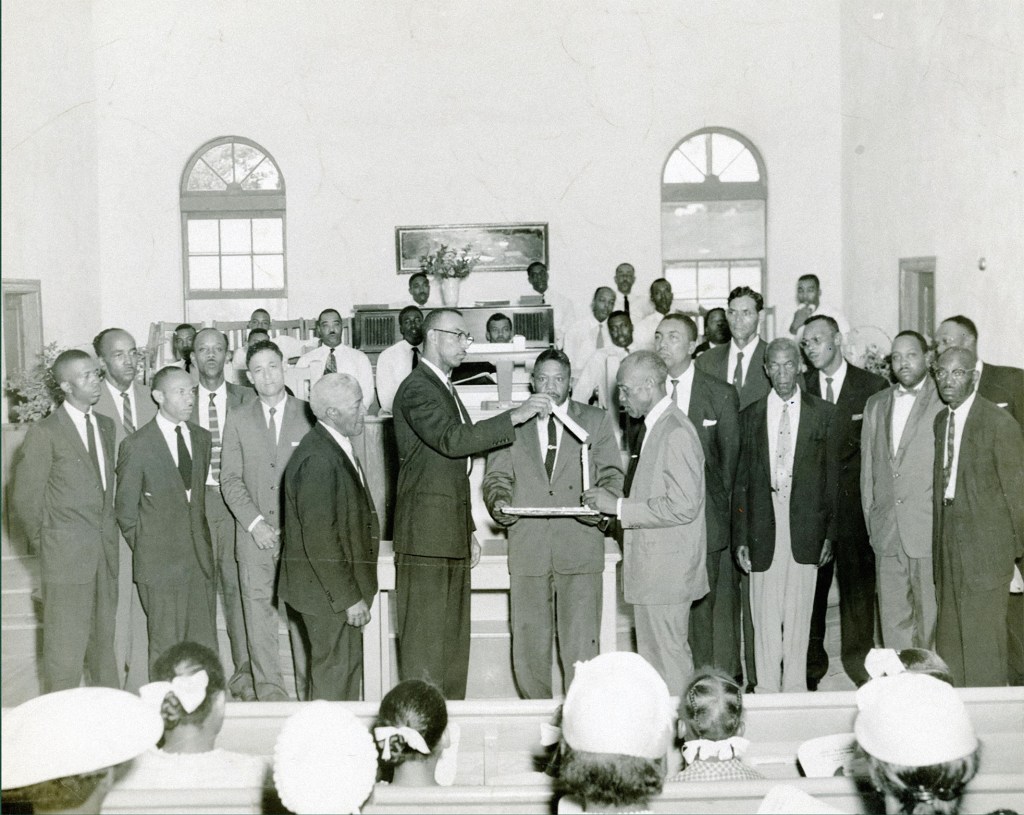
Next came Mount Zoar Baptist Church. The Mechanics and Farmers Bank, an offshoot of NC Mutual, issued a loan to cover the land purchase and construction costs of the church. Residents later held a mortgage-burning ceremony in 1960 after it was paid off.
Residents took pride in the school’s athletic accomplishments but also the school’s newspaper, the Merrick-Moore Jet, which regularly won national competitions, and its spelling bee team, which celebrated many wins against Little River High School.
Integration was difficult for the neighborhood, according to the city site. Students were bused to a different, formerly all-white school, and Merrick-Moore was converted to elementary grades, which meant residents lost the championship-winning high school that had educated many first-generation college graduates.
The Merrick-Moore neighborhood’s rural character began to change in 1984, when it was annexed to be part of the city. This brought “higher taxes and greater development potential,” according to the city site. It also brought improvements like water and sewer connections, streetlamps, and paved roads. The Merrick-Moore Community Club, a group of men who repaired homes and did yard work for those who couldn’t afford it, led the charge to get the neighborhood incorporated into city limits.
The Merrick-Moore Community Club merged with the Merrick Moore’s Ladies Club in 1997 to create the MMCDC, which still works to preserve the neighborhood.
Bonita Green, president of the MMCDC, worked with the city to collect the historic information for the Heritage Community project. Green says the desire to have recognition from Durham is to preserve the neighborhood’s history.
“I didn’t want this community to be a forgotten community, or the people who started this community or lived to thrive here to be forgotten people,” Green says.
Green was born in Merrick-Moore, and her family was one of the first to settle it. She returned to the neighborhood in 2012, and she helped the MMCDC reorganize in 2018 and become a nonprofit in 2023. The MMCDC has done extensive work to preserve its own community history.
That’s what made Merrick-Moore a good first choice for the city’s Heritage Communities program.
Karla Rosenberg, senior planner in Durham’s Planning and Development Department, along with her staff, spent six months collecting history and artifacts from community members this year. She says the process was easier because the MMCDC had already collected some oral histories and artifacts.
Rosenberg says the Heritage Communities project was created as a response to “accelerated growth and pace of development” in Durham County. There is a desire to raise awareness about existing communities that development may affect, she says.
The recognition can also be a stepping stone for a designation, which carries regulations, Rosenberg says.
“This can be sort of a launching pad, because of all the research that staff and the community conduct together, it creates just a foundation of research that makes a more formal designation that much easier,” Rosenberg says.
National Register designations are voluntary and carry a tax credit process, Rosenberg says, which could make the community more enticing for outside individuals to build in. But it also has requirements for the property’s age, significance, and integrity, meaning it has to be at least 50 years old and look similar to how it did and historically important events or people must be associated with the property, according to the National Park Service.
The City of Durham also provides local historic designations, which require zoning changes or designation declarations from the city or county and usually review from the Historic Preservation Commission.
Algin Holloway, whom Green refers to as the “resident historian,” is also a member of one of Merrick-Moore’s founding families. Holloway says the sign is “a great thing.”
“It lets people know the strides that people have made,” Holloway says.
Mount Zoar Baptist Church pastor Bernice Allen says the recognition is powerful because it will help the community have more leverage if it asks the city for assistance.
“You can put a sign up anywhere, but when someone else recognizes the work that has been done earlier, that’s the power,” Allen says. “That means the work didn’t go unnoticed. And so for work to have not been unnoticed, and for our children and children’s children to recognize what had been done and what we expect them to do, that means a lot.”
Community traditions continue today. Each October, residents gather to celebrate Mount Zoar’s founding, dressing in traditional clothing like bonnets and fundraising for the coming year. The church celebrated its 160th homecoming this year.
The city’s recognition also helps keep gentrification from wiping the neighborhood out, Green says. Her mission has been to establish the legacy of the community and its contributions to Durham. The historical sign is another step toward preserving Merrick-Moore.
“It’s a feeling of accomplishment because the initial goal of preserving the legacy of the community, it’s coming to fruition,” Green says.
Watts Welch, who has spent about 40 years of her life over time in Durham, says it’s wonderful for the community to receive recognition after years of work from community members.
“It’s nice that it was named for my great-grandparents, but that community was self-sustaining, and it wasn’t because of them that they have thrived,” Watts Welch says. “It was because of the members of that community.”
Comment on this story at [email protected].