The day before the North Carolina Chinese Lantern Festival opened, on November 13, operations manager Andrew Bowman was busy testing the lights.
For two weeks, Bowman had worked 12-to-14-hour days: unloading trucks, running power lines, overseeing crane operations. He, along with his staff, site manager Feng Lu, and a crew of 51 artists, electricians, and builders from China, was tasked with transforming a pine forest into a lantern-filled wonderland.
Now, with about 30 hours to go until the Koka Booth Amphitheatre gates opened, Bowman was adding the finishing touches, like setting up hot cocoa stands and refilling paper towel dispensers.
“In the first weeks, we’re doing macro items, like we’re physically lifting a 14-ton butterfly,” Bowman says. “But in the days right before the festival opens … we are truly trying to make sure it is show-ready. I need to make sure that every coffeepot has power and every percolator has water in it.”
The last task Bowman had was ensuring the towering evergreen in the middle of the lawn would light up on cue. The crew took their positions, ready to flip switches in sync at the end of a countdown. After a few practice runs, they managed to get the lights to come on nearly simultaneously—a preview of the big moment on November 14, when the beacon lit up to announce Cary’s 10th annual Chinese Lantern Festival.
A growing phenomenon
A decade ago, I was raving about this festival to friends who had never heard of it. The first time I stepped through the gates into a fantastical, neon-bright forest full of mythical creatures, it was like I was walking into another, more magical world. Even now, after ten years of visits, I still experience moments of awe.
In the years since, the festival has enchanted visitors from across North Carolina. In 2015, it attracted a mere 50,000 people. In 2024, about 250,000 visitors made the pilgrimage, some driving from hours away.
This year, the friends I first evangelized to about the festival are already on their second or third visit. Planning a family trip during the holidays is an exercise in perfect timing. Everyone I know is flocking to the festival.
The event began as a way for Cary officials to make money during Koka Booth Amphitheatre’s off-season. The outdoor venue had to shutter during winter months; a light display was the perfect way to keep it up and running while also creating some holiday cheer for locals.
Around the same time, a company responsible for overwhelmingly popular lantern festivals overseas—Tianyu Arts and Culture—opened a headquarters in Chicago. Cary became one of the first towns in the country to host a Tianyu festival, with its elaborate, larger-than-life lanterns in the shape of flowers, mythical beasts, and animals from the Chinese zodiac.
Koka Booth’s unusual characteristics meant it was suited for this kind of event, says William Lewis, Cary’s cultural arts manager.
“[Tianyu officials] liked the landscape a lot, the fact that we have wooded areas,” he says. “You have a viewpoint where you can see long distances, but then you can tuck back in and have intimate moments.”
Artistry and engineering
Planning for the festival is nearly a year-round endeavor, says Lewis. A month or two after the lights turn off, he and Cary staff are already talking about what improvements can be made, what new features could be put in next year.
“How do you continue to keep people in awe? That’s the challenge,” Lewis says. “You raise the bar and raise the bar and raise the bar.”
It requires a lot of creativity to keep the festival fresh, he adds, but the extraordinary detail of each lantern makes the task easier. A few years ago, the festival also transitioned to LED lighting, which consumes less power and enabled the installation of even more lanterns.
“The venue wasn’t built for this type of event, so we don’t have power in all the places we’d love it,” Lewis says. “But now with the LED and the low draw, it helps us be able to provide power in different places. You’ll notice it’s brighter out there, and there’s just more lanterns.”
“How do you continue to keep people in awe? That’s the challenge. You raise the bar and raise the bar and raise the bar.”
The lanterns themselves are made in Zingong, China, home to Tianyu’s manufacturing facilities. The building process starts with people drawing life-sized outlines of each lantern, according to the company. Metalworkers then twist and weld together steel frames to match the outline and create the lantern’s base.
Next, electric lights are installed, a combination of bulbs and LEDs. Another team drapes and glues fabric, mostly silk, onto each lantern’s frame. Painters then fill in colorful details with an airbrush or by hand.
After the majority of the work is done, disassembled lanterns are shipped to North Carolina by boat, a voyage that takes more than a month. Then, a convoy of semis drives the lanterns to Koka Booth, where the Tianyu crew reassembles and installs each lantern, with the help of the amphitheater’s operations staff.
Twenty thousand lights
In 2025, Feng Lu is the Tianyu liaison who oversees the Chinese crew. Like Bowman, Lu spends the majority of her time on-site at Koka Booth, managing every minor detail and troubleshooting.
In the five-minute walk from the gates to the pavilion, Lu is pulled aside once to talk about a problem with the central display, then fields two more service calls by phone before sitting down.
“This is a business trip for me,” she says with a smile. “I’ll be in the United States about half a year, every year.”
In the lead-up to the festival, Lu oversaw the installation of some 20,000 lights and 100,000 feet of electrical wiring, she says. In total, about 450,000 pounds of metal were used for the lantern displays. That’s not to mention all the moving and interactive lanterns, which require more complicated mechanical and electrical engineering. This year, about 30 groups of lanterns use mechanical movements, according to Lu.
Even with the LEDs, the festival has grown so large that the amphitheater’s power capacity is being tested. As Bowman says, “If there’s a spare outlet in a closet, chances are my team will be running a power cord to it.”
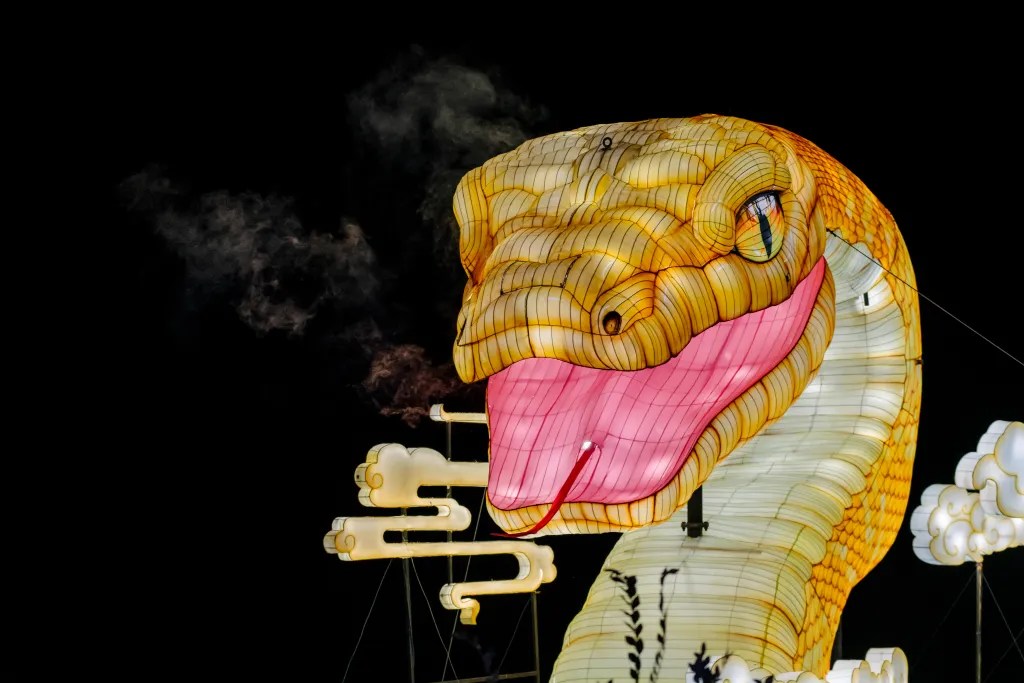
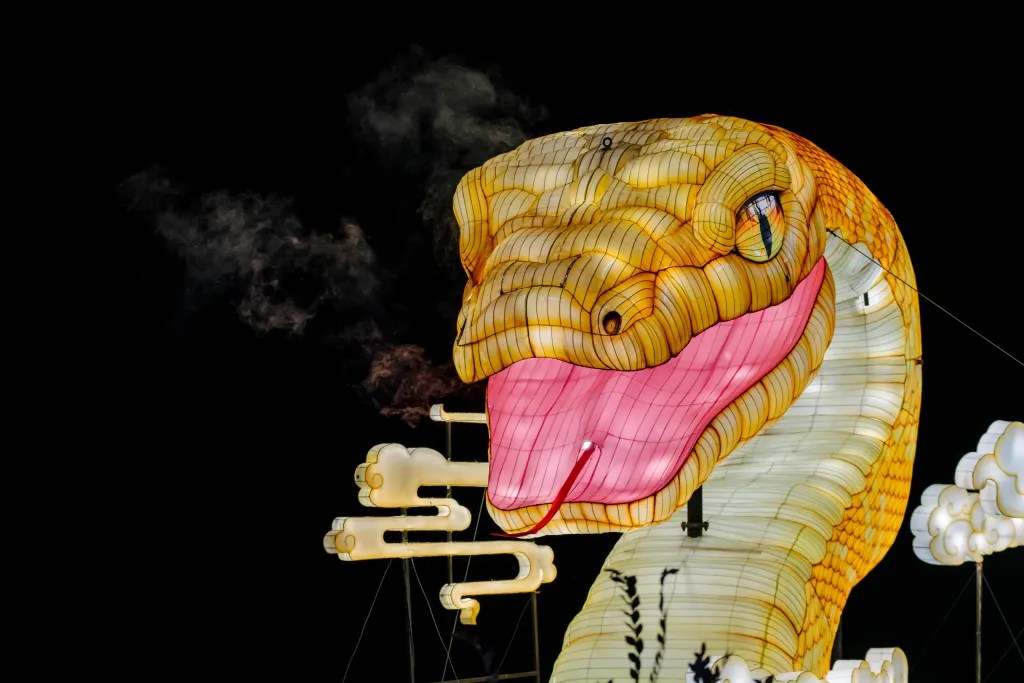
Large displays like the evergreen tree, or the two-story, 164-foot-long golden snake stretching across Symphony Lake, are installed using cranes and other construction equipment.
“It’s kind of a waltz of managing all the different components, with lots of stepping on toes due to the speed of it all,” Bowman says. Occasionally, crew members are even temporarily penned in by displays that have been built up around them … all while they were working on something else.
In addition to managing setup, Lu and a few crew members work throughout the festival to oversee any maintenance the lanterns may need. If it’s rainy or windy, fabric could be torn down, she says, or the electric system might get disrupted.
The number of people involved, the amount of physical work required, and the level of cooperation needed to hold the festival are genuinely stunning. And unlike most, the staff don’t get snow days. In fact, that’s usually when crew members are tromping around outside to fix lanterns.
A family tradition
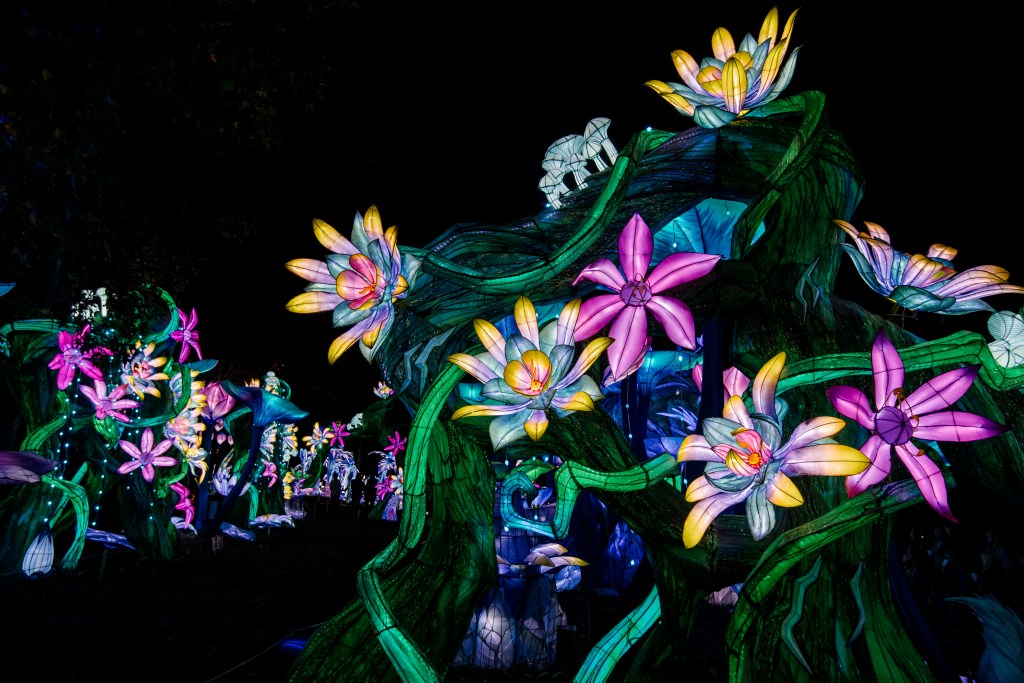
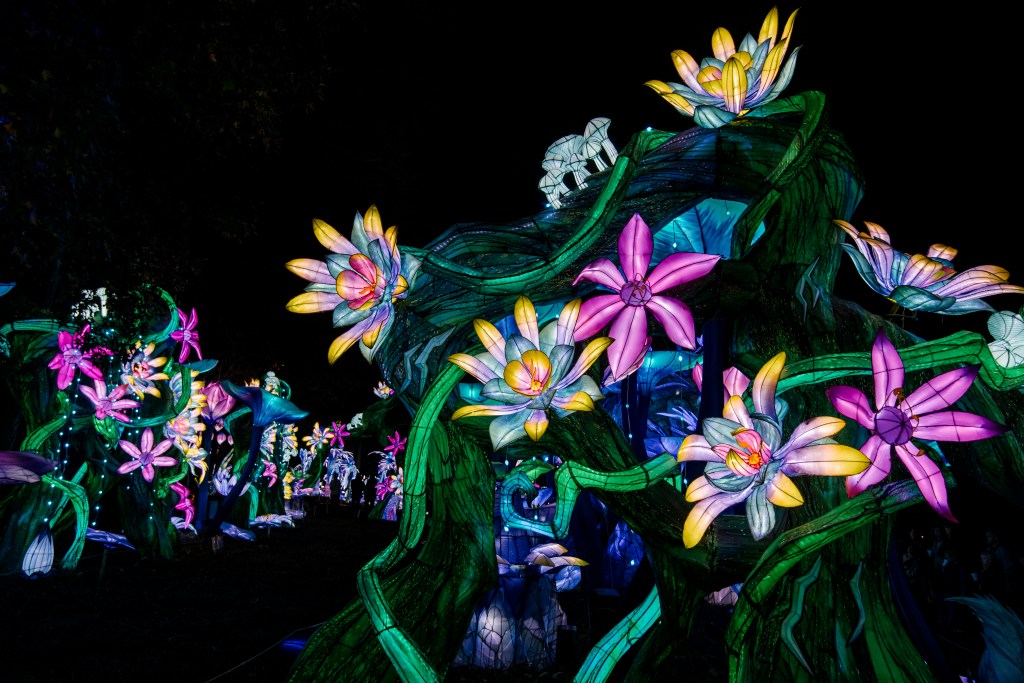
This year’s centerpiece, the evergreen tree, towers over mushrooms, colorful flowers, and elf-like beings. But for every oversized, eye-catching spectacle, there’s a tiny, charming detail that brings me a thrill of joy whenever I spot it, like the luna moths on either side of a cascading waterfall or the blue-green mountains that make up the ridges on the back of a giant whale.
Determined solo visitors might be able to speed-walk through the festival in little more than an hour, but they’d miss out on some of the most remarkable moments. As Lewis says, “There’s something around every corner.” In one hidden alcove, you can take a photo underneath a bamboo arch, complete with pandas. And you don’t want to miss reading about the zodiac animal for your birth year.

On a busy night, exploring Koka Booth’s 14-acre grounds in the crush of the crowd requires at least two hours. If you have kids, expect to spend a good chunk of time at the interactive playground, which includes swings, seesaws, and a light-up stepping pad. Still, there’s no doubt that the ticket price, lines, and tricky parking situation are all worth it.
Personally, Lewis’s favorite moment is “when you enter the front gate,” he says. “It’s a tunnel of thousands of lanterns, and it just sets the mood for, like, you’re going to experience something very different.”
This type of festival is definitely new to North Carolina, but it mirrors a much larger festival in Zigong that’s been running in one form or another for more than 1,000 years. Also known as the Spring Festival or Yuanxiao Festival, it marks the end of festivities for the Chinese New Year, which typically falls in late January or early February.
Lu and her family used to visit the Zigong festival each year, she says, the same way people here visit the Cary festival annually. For Tianyu manager Zhang Miao, the Spring Festival means eating dumplings and seeing his parents, grandmother, and great-grandmother, he says.
As unfamiliar as it is, Cary’s Chinese Lantern Festival has come to mean something similar for many in North Carolina—an opportunity to spend time with family and enjoy the holidays.
To comment on this story, email [email protected].