
More than 100 Meredith College students, faculty, and alumni rallied in front of the school’s administrative building on Monday morning wearing shades of the college’s signature maroon and carrying cardboard placards bearing messages like “We can handle the truth,” “Faculty are afraid to speak,” and “Meredith is dying.”
The community came out to protest a series of faculty, staff, and now administrative cuts at the women’s liberal arts college in Raleigh—cuts they say are affecting students’ academic experience and point to a communication breakdown between the college’s administrators and its faculty. Students also complained of on-campus living conditions, with housing that has mold, leaks, and pests.
Like other small private colleges around the country, Meredith’s enrollment has dropped over the past decade (from a 2017 peak of about 2,000 to about 1,600 today), creating new financial pressures. Publicly available tax filings show that Meredith’s annual expenses recently began to exceed its revenues. A spokesperson told the INDY this week that the college is projecting an approximately $1.8 million budget deficit for the current fiscal year. Over the summer, it tried to close that gap by laying off 6 percent of its workforce (about 25 nonfaculty employees) and eliminating about a third of all adjunct faculty.
Earlier this month, Meredith announced it would also eliminate its four academic deans, who for around 20 years have led the Schools of Business, Education, Arts and Humanities, and Natural and Mathematical Sciences. The college spokesperson, Melyssa Allen, told the INDY that the deans will be offered faculty positions and their staffs will not be laid off. Allen also said the decision “was not made for budgetary purposes” but rather to streamline the college’s structure in order to “better [support] students’ current and future educational needs” and “increase faculty’s direct access to Meredith’s [provost, Anita Thomas],” to whom department chairs will now report directly.
But faculty members tell the INDY that removing the academic deans will create extra work for department chairs—some of whom are already understaffed following this summer’s reductions. Moreover, they say the faculty wasn’t adequately consulted or forewarned about the changes.
“We’re worried about shared governance here,” says Monica McKinney, a professor in the education department and the chair of Meredith’s faculty council, an elected body that advises the administration on academic programs, policy, and the budget. She says Meredith’s recent communications with the council have been “either perfunctory, or not at all. It’s not a genuine conversation with us about how best to move the college forward.”
“I don’t know how [the provost] is going to have the time or the energy to have that many people report to her,” McKinney says. “[Thomas] says it’s not going to be extra work on [department chairs,] but I think it is going to be extra work. Morale is low.”
Allen reiterated that department chairs will not have to do extra administrative work, since “all department chairs have shared administrative support and access to the deans’ administrative assistants.” She added that the provost will continue to handle budgeting processes, and the department chairs will continue to be responsible for scheduling and course assignments.
But McKinney, the faculty council chair, isn’t alone in wondering how that will work. Multiple faculty members told the INDY the academic deans previously played an important role as an administrative layer between chairs and the provost, overseeing scheduling, budgeting, course assignments, and faculty evaluations within their schools.
One department chair who wished to remain anonymous says they believe the chairs will be asked to absorb the academic deans’ workload “with no training or education as to what all that entails, in addition to the fact that there are numerous department heads that are really, really overloaded because they’ve taken on their [former] administrative assistants’ duties as well.”
Robert Kelchen, a professor of higher education at the University of Tennessee, Knoxville, says it’s common for struggling colleges to merge academic departments in order to reduce the number of administrators and save money. But he says he’s not aware of another college that has eliminated its deans.
“If enrollment is down substantially, it might make sense to eliminate a layer of administration, as department chairs at larger institutions already handle evaluations, scheduling, and at least some budgeting,” Kelchen wrote in an email to the INDY. “But if this increases the workload of department chairs, it may be difficult to find people willing to take on that job.”
Students who attended Monday’s protest told the INDY that Meredith’s departments and course offerings shrank noticeably this semester following the summertime cuts. Several social work majors say their program only has two professors right now, down from three, which means there’s no one to teach the introductory course this semester. A sociology student says her department is also down to two professors. Some students are taking classes at neighboring schools through the Cooperating Raleigh Colleges program, and some departments have waived graduation requirements so that students can finish their degrees.
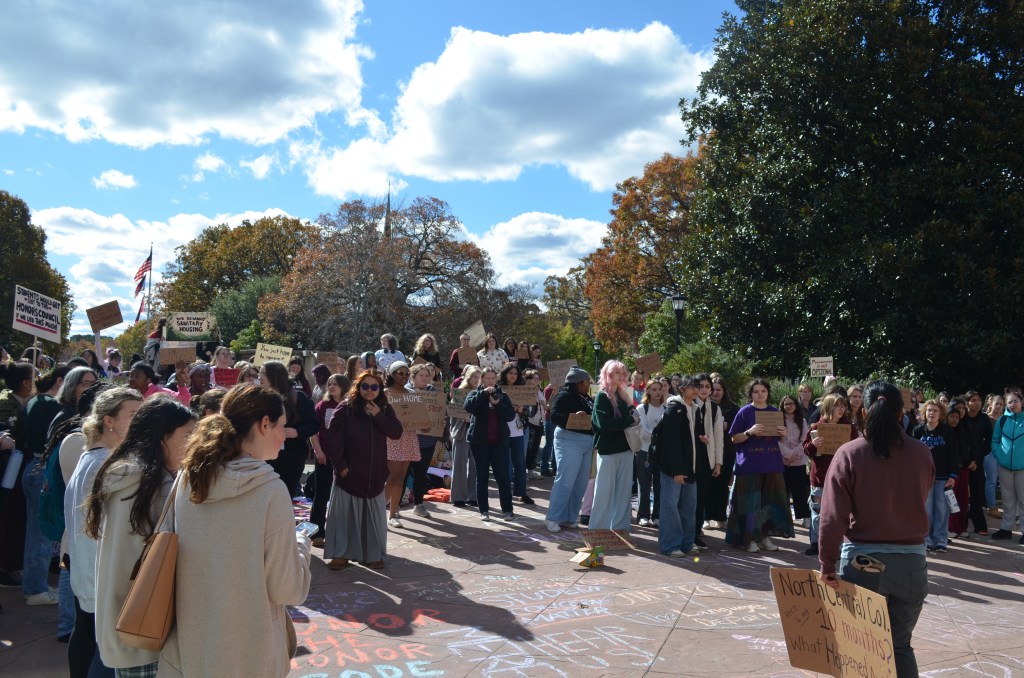
“We’re not here [protesting] because we hate Meredith or don’t like change,” says Marina Ostrowski, a social work and psychology double major. “We love Meredith, and change can be really good, but the change that we’ve seen has not really been transparent or been in the best interest of our students.”
“We all love this place,” echoes Beth Carter, an adjunct faculty member in the School of Music who was also at the protest. “I don’t like to see courses disappearing, people blindsided by changes …. Budgets have been slashed, and somehow or another, we’re supposed to function.”
“If you’re going to reorganize the academic division, the academic deans need to be involved. The faculty needs to be involved,” says Elizabeth Stewart, a class of 1996 alumna. “And they have not been, not at all.”
Allen, the Meredith spokesperson, told the INDY that “no additional structural or faculty/staff changes are anticipated in the immediate future.”
Still, many students and faculty said on Monday that they’re anxious about possible further cuts. The anonymous department chair told the INDY, “We’re still afraid our departments are going away. There’s major stress around campus in that we don’t know what’s happening and we’re left out of that conversation.”
Attendees at Monday’s rally questioned why Meredith is renovating the college president’s residence and adding a fairly new six-foot-tall ring statue on campus when there are more pressing deferred maintenance issues.
The statue, which honors Meredith’s immediate former president, appears to be a donation, and Allen told the INDY the renovation was also donor funded and is taking place “because of extensive damage to the roof and foundation.” But the optics feed into students’ and faculty members’ worries about the administration’s priorities.
“I would say no one’s necessarily protesting cuts per se,” a faculty member told the INDY during the protest. “It’s how they’re being done. The Meredith values that make this such a wonderful community are being violated.”
The day after the protest, Meredith president Aimee Sapp sent an email to employees acknowledging their concerns. She noted the college has made strides toward closing a projected $7 million budget deficit, lowering it to about $1.8 million, a difference of 75 percent. She said Meredith has seen a 24.5 percent increase in new student enrollment for this year’s fall semester, crediting the college’s new nursing program and investments in its athletics.
“If you have filled out surveys, participated in budget forums, contacted me individually, or gathered in front of Johnson Hall yesterday, I hear you,” Sapp wrote in the email, which was forwarded to the INDY. “This progress has been hard-won and made possible through a lot of creative thinking about operating reductions and making tough decisions affecting people about whom we care.”
Sapp asked employees to “please continue to share your budget ideas, stay informed by attending forums … and spread positive news about Meredith.”
“We are preserving Meredith’s ability to offer a high-quality educational experience for current and future students,” she wrote.
Chloe Courtney Bohl is a Report for America corps member. Follow her on Bluesky or reach her at [email protected]. Comment on this story at [email protected].