
Growing up with Korean immigrant parents, I learned the importance of nunchi at a very young age. If something I said or did in a social setting ever made my mom ask, “Don’t you have nunchi?” — oof — that was a gut punch comparable to “I’m so disappointed in you” in American culture. Now, as an adult(-ish), I’m grateful for my early exposure to nunchi because it’s a skill you can strengthen with practice and has helped me navigate various professional interactions and personal relationships.
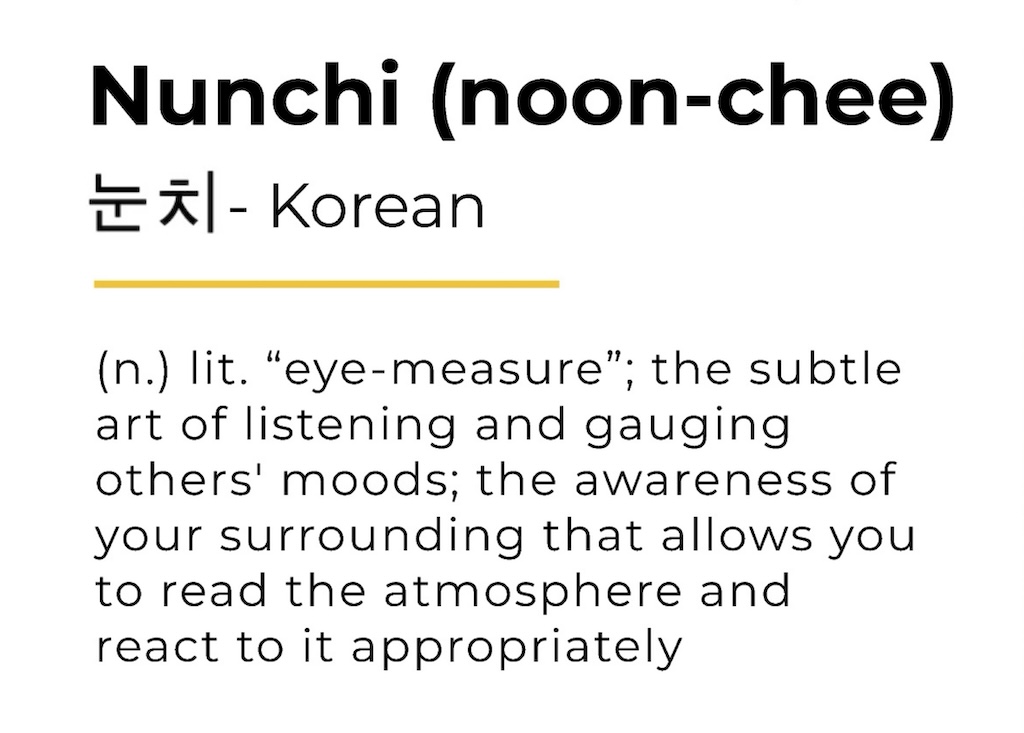
Nunchi is related to, but more nuanced than, the concepts of emotional intelligence and situational awareness. Nunchi, which literally means “eye-measure” in Korean, is the subtle, instinctive art of reading a room in any given situation by quietly observing nonverbal cues, assessing the overall atmosphere and responding accordingly.
Nunchi emphasizes the room as a whole, single organism, rather than just the individual people inside it. Because the unspoken dynamics in a room are constantly changing, speed is crucial to nunchi. The faster you read the room, the faster you can react appropriately. In fact, Koreans refer to people who are highly skilled at nunchi as having “quick” nunchi, not “good” nunchi.
Nunchi has been deeply ingrained in Korean culture for thousands of years and is a part of daily life. As a Korean American, I’ve often wished there was an exact English translation for the concept because so many interactions, both social and professional, can be perfectly summed up with two simple words: “No nunchi.”
In a social context, having quick nunchi can help avoid awkward or cringey gaffes. For example, if the atmosphere at a dinner party shifts because two guests start debating politics, you can count on the quick-nunchi guest to begin clearing the table and ask the host to describe what’s for dessert.
At work, having quick nunchi can be a powerful tool in navigating workplace dynamics and office politics. And because nunchi-strong employees excel at active listening (rather than merely waiting for a turn to talk) and responding to subtle cues/behavior (body language, facial expressions, tone of voice, silence), they tend to become those indispensable employees who earn the most growth opportunities.
To be clear, nunchi is not about being agreeable just for the sake of being agreeable. It’s about smoothing the edges of interactions and harmoniously achieving an end goal, whether that’s a relaxing dinner with friends or advancing at work.
“Regardless of who you are, or how complicated your relationships, nunchi can help you move through life in a way that feels harmonious for you and everyone you encounter,” explains Korean American journalist and author Euny Hong in her book The Power of Nunchi: The Korean Secret to Happiness and Success. And, ultimately, there’s no downside to learning to speak less, listen more and observe better.
While nunchi is a traditional Korean concept, it’s certainly not exclusive to Korea. Many of you likely already practice and sharpen your nunchi, despite having never heard the word before. If not, it’s never too late to start honing your nunchi.
As Hong points out, “Survival of the fittest, to paraphrase Mr. Darwin, doesn’t mean survival of the strongest; it means survival of those with the quickest nunchi.”
Jane Kim is the labor and employment team leader at Wright Lindsey Jennings where she represents employers, business owners and human resources leaders. She also regularly provides advice and training on employment law compliance and is an active speaker in the HR community and for women’s groups such as the Soiree Women’s Leadership Symposium and the firm’s Woman-Run initiative.
Click here to sign up for the monthly e-newsletter:

